 SUNSET:

 1
1NASA spent $2.1 billion to escape from poor atmospheric seeing; that's what it cost to put the Hubble Space Telescope in orbit. However, backyard observers on smaller budgets need not despair of improving their fuzzy, shimmering views. You can avoid the worst effects of atmospheric turbulence by understanding its nature — and learning a few tricks.
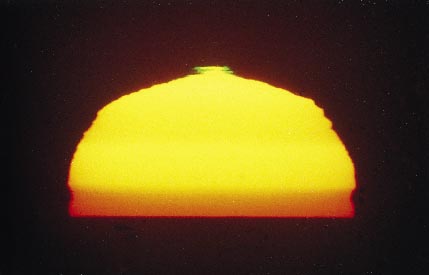
As bad as it gets: atmospheric dispersion, distortion, absorption, reddening, and refraction all at once. Wavy, flame-red sunsets are beautiful, but astronomers usually resent atmospheric effects, which compromise their views of the Moon, stars, and planets.
Marc J. Coco
Viewed at high power from the bottom of our ocean of air, a star is a living thing. It jumps, quivers, and ripples tirelessly, or swells into a ball of steady fuzz. Rare is the night (at most sites) when any telescope, no matter how large its aperture or perfect its optics, can resolve details finer than 1 arcsecond. More typical at ordinary locations is 2- or 3-arcsecond seeing, or worse. Planets appear fuzzy at high magnification and and won't quite focus. Heat waves seem to shimmer across the Moon. Close double stars that your telescope ought to resolve look single.
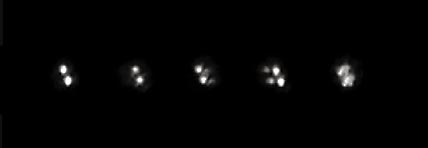
These photos show the double star Zeta Aquarii (which has a separation of 2 arcseconds) being messed up by atmospheric seeing, which varies from moment to moment. Alan Adler took these pictures during two minutes with his 8-inch Newtonian reflector.
Alan Adler
It's not hard to understand why. The usual definition of an optically "good" telescope is one that keeps all parts of a light wave entering it nicely squared up to within quarter-wavelength accuracy by the time the wave comes to focus. But that same light wave, in traversing just three feet of air inside a telescope tube, is retarded by about 400 wavelengths compared to where it would be if the telescope contained a vacuum. Clearly the air is an important optical element.
In an ideal world the air would affect every part of a light wave equally. But if the refractive power of the air down one part of the telescope tube differs from the rest by more than just one part in 1,600, the ¼-wave tolerance will be breached. Such a change results from a temperature difference of just 0.2° Celsius.
Add the miles of air that the light wave traverses before it even gets to the telescope, and it's a wonder that we can see any detail at all on objects above our atmosphere.
The air's light-bending power, or refractive index, depends on its density and therefore its temperature. Wherever air masses with different temperatures meet, the boundary layer between them breaks up into swirling ripples and eddies that act as weak, irregular lenses. You can see this where hot air from a fire or a sunbaked road mixes with cooler air above; those ordinary heat waves are astronomers' poor seeing writ large. Our windy, weather-ridden atmosphere is almost always full of slight temperature irregularities, and when you look through a telescope you see their effect magnified.
Much of the "atmospheric seeing" problem, however, arises surprisingly close to the telescope, where you can take steps to reduce it.
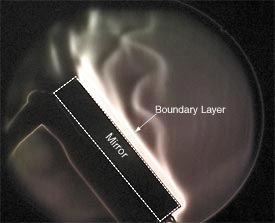
In the past, tube currents (warm air rising up the length of a telescope tube) were thought to be the principal thermal problem in reflectors, but it now seems clear that the 'boundary layer' of warm air directly in front of the primary mirror is the chief culprit.
Inside the Scope
Atmospheric seeing problems often are at their worst a fraction of an inch from your telescope's objective lens or mirror. If the objective is not at air temperature, it will surround itself with a wavy, irregular, slowly shifting envelope of air slightly warmer or cooler than the ambient night. So will every other telescope part. Therefore, one of the most important ways to "beat the atmospheric seeing" is to give your telescope time to come to equilibrium with its surroundings. Amateurs soon learn that the view sharpens within about a half hour after bringing a telescope outdoors. The full cool-down time for a large, heavy instrument may be much longer. It pays to set up early.
Usually the telescope is too warm, especially if it is stored indoors. But sometimes the opposite happens. Whenever a telescope begins to collect dew or frost, you know that it has grown colder than the air, thanks to radiational cooling. In this case gentle heat not only prevents dew but also keeps the scope closer to the air temperature — thus sharpening its resolution.
"Tube currents" of warm and cool air in a telescope are real performance killers. Reflectors are notorious for tube currents, but closed-tube Schmidt-Cassegrains and refractors can get them too. Amateurs today agree that any open-ended tube should be ventilated as well as possible. This means designing lots of open space around a reflector's mirror cell, keeping cell itself light and airy, and keeping the tube walls at least an inch away from the optical path.
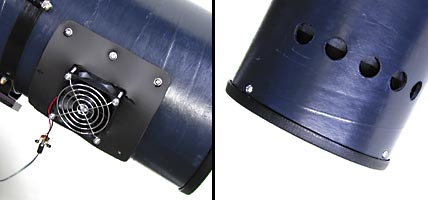
Left: Cooling fans are traditionally mounted behind a reflector's primary mirror, but inventor Alan Adler has shown that you can break up heat waves better by placing the fan in the tube's side so it blows across the mirror's face. Right: Opposite the fan, Adler put exhaust holes that allow warm air to exit the tube. Note that they're slightly offset to the rear of the tube to help ensure that the flowing air 'scrubs' the mirror before leaving.
Alan Adler
Installing a fan behind a reflector's mirror has become a popular way to speed cooling and blow out mixed-temperature air. You can easily suspend a computer muffin fan behind the mirror on rubber bands from hooks in the tube walls. The bigger the fan the better. These fans are sold at electronic supply shops. Some owners of Newtonian reflectors have improved image quality with fans built into the side of the tube just in front of the primary mirror (as shown above). Mounted this way, a fan can blow air across the mirror's front surface directly.
For decades, the conventional wisdom in the amateur world was that reflectors cannot be as optically excellent as refractors. Many books say an 8-inch reflector equals a 5-inch refractor, at least for image sharpness. The discovery of the wonders of fans in reflectors has gone a long way to ending this disparity!
Do tube currents trouble your images? It's easy to check. Turn a very bright star far out of focus until it's a big, uniform disk of light. Tube currents will show themselves as thin lines of light and shadow slowly looping and curling across the bright disk. Turn on a fan; the lines quickly swirl, break up, and almost disappear.
Near the Scope
Some atmospheric seeing problems arise just a few feet in front of the telescope. Obviously, you should try to keep your breath and body heat out of the light path. This is one reason to put a cloth shroud around an open-framework tube.
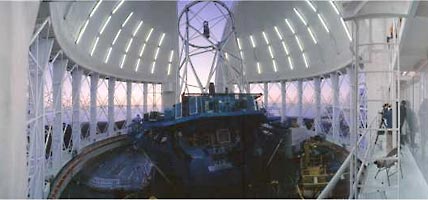
A constant gentle breeze across a reflector's primary mirror is so important that astronomers built a dome with removable sides for the 8-meter Gemini North reflector atop Mauna Kea in Hawaii.
Peter Michaud / Gemini Observatory.
A telescope's immediate surroundings should have low heat capacity so they don't store up the warmth of the day. Grass and shrubbery are better than pavement. The flatter and more uniform the greenery the better. Heated buildings are disasters of poor seeing, especially if you find yourself looking over a chimney.
If you build an observatory, use thin materials that cool quickly: plywood or sheet metal, not masonry. Paint it white or a very light color to reflect solar heat. (Special heat-reflective paints are available; they reflect infrared as well as visible light.) Ventilate the building very well. A thick rug belongs on the floor.
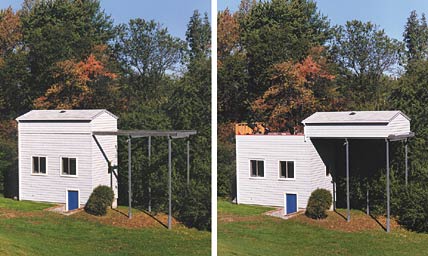
Dennis di Cicco's three-story observatory has a roll-off roof, allowing his telescopes to quickly reach thermal equilibrium with the outside air. He also finds the atmospheric seeing to be noticeably better high up than at ground level. Being surrounded by grass and trees rather than asphalt or brick also helps. Of course, the lower floors of the building are unheated!
S&T / Dennis di Cicco.
A roll-off roof that opens the whole room to the sky provides quicker cooling and better seeing than a dome with a chimneylike slit. If you insist on a dome, install a large fan in one wall to suck air down through the slit past the telescope, just as professional observatories do. It's widely considered a poor idea to put an observatory on a heated house unless you resign yourself to low-power work. If you must do so, try to put it on the upwind side — and make sure the floor of your attic is well insulated and the attic is well ventilated.
Much poor seeing hugs the ground, so an elevated observing platform is a good idea if you can manage it. A telescope is likely to show the stars and planets more sharply if you can get it up just a few feet closer to them.
High-Altitude, Atmospheric Seeing
Now we come to the unavoidable heart of the problem. There's not much you can do about the air thousands of feet up. But you may be able to predict when and where it will be smoothest.

Telescope users recognize two types of atmospheric seeing: "slow" and "fast." Slow seeing makes stars and planets wiggle and wobble; fast seeing turns them into hazy balls that hardly move. You can look right through slow seeing to see sharp details as they dance around, because the eye does a wonderful job of following a slowly moving object. But fast seeing outraces the eye's response time.
An old piece of amateur folklore is that you can judge the atmospheric seeing with the naked eye by checking how much stars twinkle. This often really does work. Most of the turbulence responsible for twinkling originates fairly near the ground, as does much poor seeing. But rapid, high-altitude seeing escapes this test. If the star is scintillating faster than your eye can follow (the eye's response time is about 1/10 of a second), the star will appear to shine steadily even if a telescope shows it as a hazy fuzzball.
Astronomers often talk of seeing cells — air-eddy lenses, millimeters to meters across, that swarm through the sky. These eddies originate wherever air masses rub past each other — either horizontally in winds, vertically by convection, or both. Sometimes, when watching an extended object like the Moon or a planet, you can focus the telescope on a horizontal layer of "shear turbulence" a few thousand feet high. The ripples sharpen up when you turn the focuser slightly to the outside of infinity focus (moving the eyepiece farther from the objective). This is the signature of an inversion layer, in which a mass of warm air flows across cooler air below. The actual temperature difference may be very slight.
Large or slow-moving eddies cause slow seeing, but they don't stay large forever. No matter what size the eddies are when they originate, they break up into smaller and smaller ones. When these finally become small enough to measure in millimeters, they die out and dissipate their energy as heat via the air's fluid friction (viscosity).
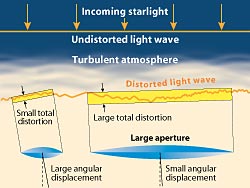
A light wave from a star is distorted on many size scales by the atmosphere. When the wavefront enters a telescope, its 'tilt' determine's the star's apparent position, while its 'roughness' determines how fuzzy the star looks. Generally a small telescope sees a relatively sharp star dancing around, while a large one sees a relatively steady but fuzzy star.
Sky & Telescope
This complex situation belies an often-repeated piece of astronomer's lore: that seeing cells are 10 centimeters (4 inches) in size. In fact they come in all sizes. But cells in this middle range do have an important property: they affect a large telescope more seriously than a small one. If you have a 4-inch scope, cells 4 inches and larger passing through its line of sight will make an image move around while staying relatively intact. The same cells passing in front of a 12-inch aperture will superpose multiple images at once.
This fact has led to another piece of folklore: that when the atmospheric seeing is bad, a large telescope shows less detail than a small one. Therefore, supposedly, you can improve the view in poor seeing by stopping down a large aperture with a cardboard mask.
Technically there is a bit of truth in this, but in practice the improvement is nonexistent. I have never seen any improvement by stopping down a telescope when the problem was poor seeing. The most that can usually be said is that on a really rotten night, large- and small-aperture views will be equally poor. Even then, if you constrict the aperture you miss the chance for the momentary high-resolution views that the full aperture will provide if the air briefly steadies.
There are reasons why you may indeed see more sharply through a stopped-down telescope. Most of them are bad — and have nothing to do with the atmosphere. Maybe your eye was dazzled by a too-bright planet; in that case an eyepiece filter would solve the problem better than a reduced aperture. Maybe the aperture stop is masking off the optical errors of a flawed objective. Maybe it's just allowing a mediocre eyepiece to perform better by increasing the telescope's f/ratio. Poor collimation of the optical parts is also less damaging when the f/ratio is increased.
On a reflector or Schmidt-Cassegrain, a small, off-axis mask can give you the advantage of a clear aperture. A clear aperture, mathematical analyses have shown, is slightly less affected by atmospheric turbulence than an obstructed one. But in this case the loss of aperture is huge.
In Search of Steady Air
The seeing quality depends on the weather, but not by simple rules that apply everywhere. Poor seeing does seem more likely shortly before or after a change in the weather, in partial cloudiness, in wind, and in unseasonable cold. Any weather pattern that brings shearing air masses into your sky is bad news. Good seeing is most likely when a high-pressure system settles in to bring clear skies for several days running. Keep a seeing-versus-weather log for your locality, and you may discover correlations that will become your key to sharp viewing.
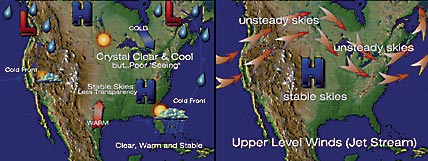
Left: On this typical surface-weather map, crystal-clear skies sweep eastward behind a storm center (a low-pressure system indicated by a red letter L) and the cold front that moves away from the northeastern United States. Right: The position of the jet stream often is a good indicator of how steady the skies will be. When a high-pressure ridge bends the jet stream north, observers to the south may enjoy steady skies. Those beneath the jet stream will likely have poor seeing.
Seasonal patterns are more predictable. The atmospheric seeing is often mediocre in the cold months over the northern United States and southern Canada, when the high-altitude jet stream flows above these latitudes. The jet stream being overhead always spells trouble. The very best seeing often comes on still, muggy summer nights when the air is heavy with humidity and the sky looks unpromisingly milky with haze. Some astronomers claim that a blanket of industrial smog steadies the air as effectively as summer humidity — or rather that it results from the same tranquil air masses.
Time of night also plays a role, but again there are few universal rules. Right after sunset the seeing is apt to be excellent, so start your planetary observing as soon as you can find a planet in twilight. The seeing is apt to deteriorate before dusk fades out. Some observers find that their seeing improves after midnight; others say it goes to pieces. This depends largely on local topography; observers in valleys might get worse seeing as the night goes on and cold air flows down to pool in the valley. Just before sunrise may be another excellent time.
For observing the Sun (use an astronomer's solar filter!), the best time is early morning before the Sun heats the landscape. The very worst atmospheric seeing of the 24-hour daily cycle comes in the afternoon.
Geography is critical. Smooth, laminar airflow is the ideal sought by observatory-siting committees worldwide. The best sites on Earth are mountaintops facing into prevailing winds that have crossed thousands of miles of flat, cool ocean. You don't want to be downwind of a mountain; the airstream breaks up into turbulent swirls after crossing the peak. Nor do you want to be downwind of varied terrain that absorbs solar heat differently from one spot to the next. Flat, uniform plains or gently rolling hills extending far upwind can be almost as good as an ocean for providing laminar airflow. You may learn to predict which wind direction brings the best seeing to your observing site.
One easy countermeasure when observing bright objects such as the Moon and planets is to use a color filter. Different colors seem to shimmer out of phase with each other in the seeing (that's why bright stars twinkle in colors), and in a telescope this contributes to the general fuzzing up. A planet's blue image may line up with its yellow image one instant and separate from it the next. If you isolate just the yellow light, for instance, the planet will often appear to quiet down noticeably — at least when seen through a small-aperture scope.
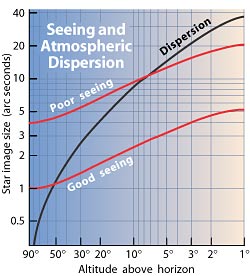
Atmospheric blurring gets worse the lower you look. Atmospheric dispersion elongates a star into a colorful little spectrum; close to the horizon this effect overtakes even poor seeing as a cause of blurry images.
S&T illustration / Source: Andrew T. Young.
A color filter is especially useful when you're aiming at altitudes lower than 45° above the horizon. The atmospheric seeing is always worse at low altitudes in the sky because you're looking through more air. In addition, you face more atmospheric dispersion. This is the smearing out of a celestial image into a short spectrum, with blue on top and red on the bottom. Even as high as 60° up, the far-blue component of an image appears 0.9" (0.9 arcsecond) above the far-red component. The difference is 1.5" at 45°, 2.5" at 30°, and 5" at 15°. Your eye is fairly insensitive to light at the extreme red and blue ends of the spectrum, so dispersion really doesn't look quite as bad as this. Still, filtering out all but one color in a swarm of chromatic aberration will sharpen your view. In the summer of 1994 I found a yellow or orange filter invaluable for following the dark spots on Jupiter caused by the impacts of pieces of Comet Shoemaker-Levy 9; because Jupiter was quite low near the horizon.
Mostly, though, beating the atmospheric seeing is just a matter of patience. Just keep watching, and intermittent good moments may surprise you. One reason why experienced observers see more detail on the planets than beginners do is that they simply watch longer, ignoring all but the steadiest moments. Moreover, the seeing can change as radically from minute to minute as it does from second to second. When that perfect minute comes along, the dedicated observer is the one most likely to be there at the eyepiece to catch it.

Comments
You must be logged in to post a comment.