 SUNSET:

 17
17NASA will probably not build a full-fledged outpost on the Moon as originally planned, the agency's acting administrator, Chris Scolese, told lawmakers on Wednesday, April 29th. His comments also hinted that the agency is open to putting more emphasis on human missions to Mars or a near-Earth asteroid.
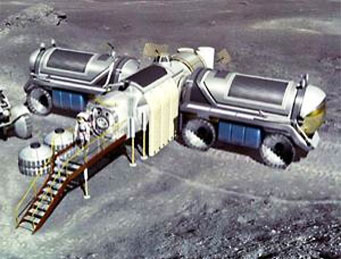
Instead of building a permanent lunar base, as in this illustration, NASA may send astronauts on only short lunar excursions and put a higher priority on getting humans to Mars or an asteroid.
NASA
NASA has been working toward returning astronauts to the Moon by 2020 and building a permanent base there, following a policy directive by President George W. Bush in 2004. But some space analysts and advocacy groups, such as the Planetary Society, have urged NASA to cancel plans for a permanent Moon base, carry out shorter Moon missions instead, and focus instead on getting people to Mars.
Under Scolese's predecessor, Mike Griffin, NASA held firm to its Moon-base plans. But the comments by Scolese, who will lead NASA until President Barack Obama nominates the next administrator, suggest a shift in the agency's direction. He spoke to the Subcommittee on Commerce, Justice, Science, and Related Agencies of the House Committee on Appropriations.
Scolese was asked repeatedly whether NASA could still make it to the Moon by 2020 under the proposed 2010 budget, but he failed to give a clear yes or no, and his answers suggest that the agency's plans are in flux.
Short trips
"We were looking at an outpost on the Moon, as the basis for that [2020] estimate and that one is being revisited," he said. "It will probably be less than an outpost on the Moon, but where it fits between sorties, single trips, to the Moon to various parts and an outpost is really going to be dependent on the studies that we're going to be doing."
"Recall [that] the Vision [for Space Exploration] was not just to go to the Moon as it was in Apollo, it was to utilize space to go on to Mars and to go to other places," he added. "We've demonstrated over the last several years that with multiple flights we can build a very complex system reliably – the Space Station – involving multiple nations… and we'll need something like that if we're going to go to Mars."
Scolese's further comments hinted that the agency's plans might shift to include a greater emphasis on destinations beyond the Moon. "So what I would like to see from NASA over time is an architecture that… will give us flexibility for taking humans beyond low-Earth orbit and allowing us to have options for what we can do at the Moon as well as other destinations… [like] Mars or an asteroid… so that there are options on what we do in 2020," he said.
Vague answers
Scolese's vague answers on whether NASA believes it could meet its 2020 Moon deadline, as well as similarly unclear answers from Doug Cooke, NASA's associate administrator for exploration systems, left the subcommittee's chair, congressman Alan Mollohan (D-WV), wondering whether the agency had been given new directions.
"Does the 2010 budget request impact in any way our target – is this so complicated – our target of getting to the Moon by 2020?" he asked. "Is there any consideration being given within the organization to not attempting to meet the 2020 Moon [return]…. Is there any reconsideration of going there? What is going on here?"
Cooke replied: "The direction that we have is to continue to pursue the 2020 date," but he added that the agency was still assessing how the 2010 budget might affect that.
Some clarification about any shift in NASA's goals and priorities could come in early May, when the Obama administration's detailed 2010 budget proposal for NASA is set to be released.
Courtesy New Scientist.

Comments
dbane
May 1, 2009 at 10:06 am
Maybe now NASA will get out of the way and let Private Enterprise put together a Colony. We could then rent out space to NASA!
You must be logged in to post a comment.
dbane
May 1, 2009 at 10:06 am
Maybe now NASA will get out of the way and let Private Enterprise put together a Colony. We could then rent out space to NASA!
You must be logged in to post a comment.
I really hope I'm not being just another wacko here
May 1, 2009 at 10:43 am
I have a basic question about all this: once we actually get back to the Moon (hopefully to stay), won't we first have to dig a deep hole to serve as a radiation shelter?
Isn't the (essentially unsolved) problem of random radiation events coming from the Sun the real problem with long-duration space travel not becoming reality yet?
Then, there's the constant background radiation from every other gamma event in the universe making for dismal prospects for extended spaceflight above the magnetic field.
I'd dearly love to be conclusively refuted here, preferably by someone deeply into aerospace technology.
You must be logged in to post a comment.
Frenchie
May 1, 2009 at 11:08 am
In an answer to that question just build on the dark side of the moon, so there will be no direct radiation from the sun, just a thought, that might help, I am no rocket scientest by a long shot, have a good one
You must be logged in to post a comment.
Frenchie
May 1, 2009 at 11:12 am
I think they better take a small step rather than a large leap to Mars. Better to have a Station on Mars just in case stuff goes wrong and to learn the difficulties in building a space station on a moon,planets or whatever. It is a long ways to earth from mars especially if they forgot a couple of wrenches, they better wake up, and with the extremes of the planet, they don't really have a clue. something goes wrong there they are fracked on Mars. Practice on the Moon first then do it on Mars
You must be logged in to post a comment.
Frenchie
May 1, 2009 at 11:16 am
Correction on Prior Post, I intended to say Moon not Mars to build the First Station to be Built, the people building this will need to learn from their mistakes closer to home rather than father away on Mars, something goes wrong on Mars it will end up a terrible travesty
You must be logged in to post a comment.
Physicist
May 1, 2009 at 11:47 am
Frenchie: there is no such thing as the dark side of the Moon. There are regions next to the poles where you can find a relief depression screening the base from the Sun most of the time.
You must be logged in to post a comment.
jacques
May 1, 2009 at 3:39 pm
Yes, except in some very rare places, Moon, like the Earth, gets sun in all its regions ! It is not because we always see the same side of the Moon (almost, let s forget about libration here) that the sun does not reach every region of the Moon ! Better call it the far side of the moon, or in French, la face cachee, the hidden side of the Moon !
You must be logged in to post a comment.
Star Rocker
May 1, 2009 at 6:21 pm
Hi Frenchie,
Jacques is right. "The dark side" of the Moon is wherever it is night time. Due to librations and such the "dark side" is always changing, it doesn't "stay the same". Of course now, some group of philosophers have said that "There is no Dark Side of the Moon, really. In matter of fact all the Moon is dark". 😉 Have a good weekend. Keep cool.
You must be logged in to post a comment.
chuck
May 1, 2009 at 6:45 pm
well I guess it did not take him (obama) long...now he has done away with all the work of countless people and money..wonder what he will do now. maybe the chineisis or the Irainians can have a moon base..sounds like our space program is headed for the same thing as wallstreet..I Hope Not..NASA is at the mercy of the gov.However,,for now this is still a democrocy..call your congressman let them know what the endevor is really about...better yet TELL OBAMA...or in his words be satified with less............just an opinion...........
You must be logged in to post a comment.
Tom Whiting
May 1, 2009 at 6:54 pm
I think you'll find that the real problem is...water ice,
or lack of it. If there's no water-ice present, then
we ain't going for a long duration to the moon as we can't be hauling all that water around. Evidently the evidence is pretty slim for water-ice on the moon, unlike Mars.
That's my take.
Tom W.
You must be logged in to post a comment.
Astrono
May 1, 2009 at 7:58 pm
Hi all!
I sure would like to see us go back to the moon and camp out there and get the travel bugs out of a longer mission to Mars.
It just seems like it makes logical common sense.
The Wright brothers did not go from Kitty Hawk flights to flights over the Atlantic.
Why go from ISS and try to jump to Mars too quickly?
Just my thoughts now.
Keep Looking up!
You must be logged in to post a comment.
Don
May 2, 2009 at 5:35 am
I was hoping that with Bush gone, we might actually get science stuff decided by... well... scientists. Are there _any_ non-vested scientists who are aware of the issues involved that think that a Mars mission is worth-while, let alone feasible? For the same money we would spend trying to get 1 person to Mars, we could probably start 10 lunar colonies. And yes, I made that statistic up out of thin Martian air. 🙂
You must be logged in to post a comment.
Gene
May 2, 2009 at 6:50 pm
I have to say that I saw this coming. These are just the first weasel-words in the retreat from space. Obama doesn't like space just like he doesn't like the veterans. We vets are alreayd getting cut and NASA will get cut, too, in the same sneak NON-TRANSPARENT fashion. Just you wait and see ... and the ISS? I'm sure the day is coming when it will be left to other countries to run it because we, soon, will have no way to reach it and I don't see any progress at all on Orion. Say "Goodbye" to space exploration, it's been fun.
You must be logged in to post a comment.
Gene
May 2, 2009 at 6:50 pm
I have to say that I saw this coming. These are just the first weasel-words in the retreat from space. Obama doesn't like space just like he doesn't like the veterans. We vets are alreayd getting cut and NASA will get cut, too, in the same sneak NON-TRANSPARENT fashion. Just you wait and see ... and the ISS? I'm sure the day is coming when it will be left to other countries to run it because we, soon, will have no way to reach it and I don't see any progress at all on Orion. Say "Goodbye" to space exploration, it's been fun.
You must be logged in to post a comment.
space hitchhiker_9
May 2, 2009 at 8:43 pm
What about using the Bigelow modules for shelters and SpaceX dragon for transportation. How about moon vacations? What would a package cost $100K??
will a Bigelow module fit in the Dragon cargo area??
You must be logged in to post a comment.
Art Riaf
May 4, 2009 at 1:16 pm
What is wrong with the system used in the movie 2001. An orbiting space station that has the resorces to build and send ships to the moon or mars. A base on the moon will be hard to support without earth to the moon shipments. A depot in space part of the way there can supply both local and distant projects. If a problem on a moon base needs attention a ship from the earth will take longer and be more expensive to send. In orbit platforms for all missions is the way to go in the long run.
A Riaf
You must be logged in to post a comment.
You must be logged in to post a comment.