 SUNSET:

 18
18When NASA launched twin Pioneer spacecraft toward the outer solar system in the early 1970s, there was no dilly-dallying.
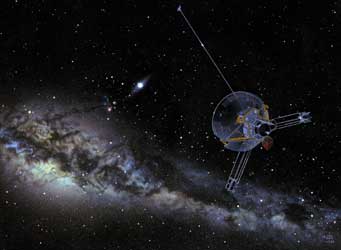
An artist's concept of a Pioneer spacecraft in interstellar space. NASA maintained contact with Pioneer 11 until November 1995 and with Pioneer 10 until January 2003.
NASA / Don Davis
Rocketing away from Earth at more than 32,000 miles (51,000 km) per hour, Pioneer 10 reached Jupiter in just 21 months. Pioneer 11 followed about a year later, then boomeranged out to Saturn. By 1979, their planet-hopping days were over.
But even as they coasted outward toward the stars, the craft continued to radio their whereabouts and a trickle of scientific data back to Earth — and that's when dynamicists noted something very odd: neither spacecraft was as far away as expected. Instead, it was as if some unknown force were adding a little extra tug back toward the Sun.
Over the years, many theorists have weighed in on the possible cause of the "Pioneer anomaly." Logically, a few speculations focused on measurement errors, propellant leaks or some unanticipated property of the spacecraft.
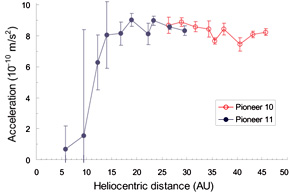
Early unmodeled sunward accelerations of Pioneer 10 (from about 1981 to 1989) and Pioneer 11 (from 1977 to 1989). Values nearest the Sun are uncertain because solar gravitational and radiation pressure forces are large.
J. D. Anderson & others
Others explored the Pioneers' interactions with the solar wind, solar radiation pressure, or interplanetary particles. And more than a few were "out there," conjuring a pull imparted by unseen masses, variations in Newtonian physics, and controversial notions of altered space-time.
Five years ago, after many years of painstakingly dredging up old tracking data and reconstructing the probes' trajectory, Slava Turyshev (Jet Propulsion Laboratory) announced that some (but not all) of the retarding force was due to heat radiating away from the spacecraft unevenly.
Now four Portuguese physicists have taken a closer look at how the Pioneers radiated their heat. Key to their analysis is a technique used in computer-graphic programs known as Phong shading. It keeps track of light's diffuse and specular reflections off a surface and uses polygons to model curved surfaces.
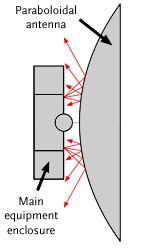
A simplified model of the Pioneer 10 and 11 spacecraft shows how waste heat (red arrows) reflected off the back side of the communications antenna.
F. Francisco & others
Led by Frederico Francisco of Lisbon's Instituto de Plasmas e Fusão Nuclear, the team finds that waste heat from each spacecraft's main equipment compartment was reflecting off the back of the 9-foot-wide (2.7-m) paraboloidal antenna that always pointed inward toward the Sun and Earth.
Just how much heat was bouncing around remains unclear: "The main difficulty in dealing with this problem has always been the lack of sufficient and reliable information for a detailed engineering modeling of the spacecraft," they write. However, by assuming a range of plausible values, they calculate that the tiny force resulting from those reflections closely matches the Pioneers' observed deceleration.
"Unless new data arises," they conclude, "the puzzle of the anomalous acceleration of the Pioneer probes can finally be put to rest."

Comments
Kenneth Frankel
April 5, 2011 at 5:35 pm
Pioneer 10 launched March 2, 1972, and came closest to Jupiter Dec. 3, 1973.
Pioneer 11's dates are Apr. 5, 1973 and Dec. 2, 1974.
So it took longer than 4 or 7 months.
Even the New Horizons mission to Pluto took about 13 months
to pass Jupiter.
What were you thinknig of? Perhaps the time it took to get
to the asteroid belt?
You must be logged in to post a comment.
Kelly Beatty
April 6, 2011 at 6:10 pm
Ken: thanks for keeping me honest: I misread the launch and arrival dates in my sourcebook and have corrected the story.
You must be logged in to post a comment.
Peter Wilson
April 6, 2011 at 10:01 pm
"The main difficulty in dealing with this problem has always been the lack of sufficient and reliable information for a detailed engineering modeling of the spacecraft," they write. An over-density of dark matter in the solar neighborhood would have been more fun.
You must be logged in to post a comment.
Edward Schaefer
April 7, 2011 at 3:25 pm
It is nice to have a tenable explanation for this effect. I for one have played with creating an alternative to GR, and at one point looked to the Pioneer anomaly as possible evidence favoring my ideas. I immediately ran hard up against a problem: This effect is way, way too big to be accounted for by the second-order deviations in the Post-Newtonian approximations that distinguish my ideas from GR. Also, my ideas utterly failed to account for the near-constancy of the magnitude of the anomalous acceleration.
OTOH, the Pioneer anomaly as a result of waste heat neatly explains its constancy: Operations have been ongoing at a fairly steady level ever since the planetary phase of these missions ended. In hindsight, all gravitation-based models are given tremendous difficulty by that aspect of the anomaly. So my hat's off to Dr. Francisco and his team.
You must be logged in to post a comment.
Mace
April 8, 2011 at 10:37 am
It could have been little green men hitching a ride on the rear bumber. *That* would have been more fun!
You must be logged in to post a comment.
notsosure
April 8, 2011 at 11:47 am
Maybe it's just my lack of training in physics but isn't this explanation somewhat like installing a giant fan on a sailboat to blow the sails? Doesn't seem like radiated heat reflecting off any surface of the same vehicle can impart any force other than net zero to the system.
You must be logged in to post a comment.
James Lummel
April 8, 2011 at 1:19 pm
It's not like a fan on a sailboat, it would act more like the reverse thruster on the jet engines on a 737 aircraft.
When the plane slows down after landing, two re-directors on either side of the exhaust opening are placed in the path of the jet exhaust, and that re-directs the force opposite the direction of travel and helps to slow down the aircraft, acting as a brake (I've traveled in many 737's and have seen this multiple times).
Here the back of the dish is acting as a re-director in the path of the heat, re-directing it in opposition to the direction of travel and acting as a brake. Without the dish, the Pioneer anomaly would been a slow acceleration rather than a slow deceleration.
James
You must be logged in to post a comment.
Michael Hennebry
April 8, 2011 at 1:27 pm
Replace the fan with a tank of compressed air *attached to the sailboat*. Place the whole works in a vacuum. If the sail is too small, the boat will go backwards. If the sail is big enough, the boat will go forwards. Heat radiation measurably affects the orbits of some asteroids.
You must be logged in to post a comment.
Rudy
April 8, 2011 at 2:33 pm
What happened to the thrust associated with the release of the heat, or as a radiant energy is there no force that balances out that which impacts the antenna?
You must be logged in to post a comment.
Don
April 8, 2011 at 2:39 pm
If the Pioneer space craft is slowing down, will it come to a full stop at some point? If not a full stop slowed enough where it does not make any more meaningful progress in any flight? If it will stop, can we project where the place and time when this might occur?
You must be logged in to post a comment.
Joe
April 8, 2011 at 3:44 pm
Reply to Rudy: You are right that there is a thrust associated with the emission of the infrared radiation, but the thrust in the opposite direction when it is reflected is twice as large (the photons are stopped and re-emitted in opposite direction).
You must be logged in to post a comment.
Edward Schaefer
April 8, 2011 at 10:54 pm
Rudy -
The heat being emitted from the main equipment enclosure is balanced. So my opinion is that without the antenna, there would be no Pioneer anomaly. However, do realize that light (even infared light/heat) carries energy and momentum. The antenna is bouncing some of the heat which is initially directed sunwards in the anti-sunwards direction. The action is a change of momentum for the heat in the anti-sunwards direction, and so the spacecraft reacts to it with an tiny acceleration in the sunwards direction.
You must be logged in to post a comment.
Edward Schaefer
April 8, 2011 at 11:14 pm
Rudy -
The Pioneer spacecraft are headed out towards the stars, and the acceleration from this anomaly is way too small to stop that.
To top that off, the spacecraft are now all but out of power due to the decay of the radioisotopes in the RTGs that powered them. No power = no heat, and means no more anomaly. So they are headed for the stars, unimpeded.
You must be logged in to post a comment.
John Palk
April 9, 2011 at 7:12 am
"What happened to the thrust associated with the release of the heat, or as a radiant energy is there no force that balances out that which impacts the antenna?"
I was thinking the same thing as the others who thought this didn't make sense, and then all of a sudden I realized my mistake, so I will try to explain.
If there was no dish and the heat was allowed to escape freely, the probes would slightly accelerate, but instead the heat hits the dish. If that was the end of the story, you would all be correct, the heat hitting the dish would negate the effect of the heat escaping; but it is not the end of the story, the heat then reflects off and heads into space causing deceleration.
Hope that helps.
You must be logged in to post a comment.
Dave
April 9, 2011 at 9:21 am
"Without the dish, the Pioneer anomaly would been a slow acceleration rather than a slow deceleration."
I suspect that the diagram is also over-simple in not showing heat radiating from all sides of the equipment enclosure, not just the side facing the dish. Assuming the radiation is essentially uniform and symmetrical, there would be no acceleration or deceleration if the dish were not present.
Also, the dish should act as a very small "solar sail", giving a net accleration away from the Sun, but I assume that this effect was taken into account is trying to explain the anomaly.
It is interesting to note how much more these forces, external and from the spacecraft itself, must have to be taken in account in the design of spacecraft such as the Webb telescope, which have much larger surfaces in proportion to their mass (I suspect) and operate in the inner solar system where light pressure and radiant forces would be vastly larger than those expereinced by the Pioneers.
You must be logged in to post a comment.
Yaron Sheffer
April 9, 2011 at 1:38 pm
Here's an older suggestion for the same effect:
http://arxiv.org/abs/gr-qc/9809070
which is almost 13 years old...
You must be logged in to post a comment.
Warren
April 9, 2011 at 3:10 pm
> If the Pioneer space craft is slowing down,
> will it come to a full stop at some point?
The paper (linked from the article above) touches on this subject. Hint: The nuclear fuel in the power source is slowly decaying.
You must be logged in to post a comment.
Wayne Boese
May 26, 2011 at 5:15 pm
“The main difficulty in dealing with this problem has always been the lack of sufficient and reliable information for a detailed engineering modeling of the spacecraft,”
One would think that NASA could and would make this information available after all they know what they rocketed into space. I am sure they did not throw away the plans. One of NASA’s charters is the free exchange of information, so why haven’t they provided this information to the scientists. Alternatively, the scientists could apply under the Freedom of Information Act for the information.
You must be logged in to post a comment.
You must be logged in to post a comment.