 SUNSET:

 2
2It's Sunday morning, and I'm about to return for the second day of the Pacific Astronomy and Telescope Show.
S&T: Tony Flanders
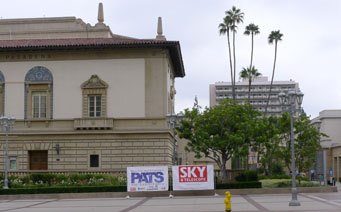
PATS, which began in 2008, is the big West Coast telescope trade show. It takes place indoors at the Convention Center in Pasadena, California, which is between the beautiful, historic downtown district and the Caltech campus. There's outdoor Sun viewing and, in the evening, public outreach at the Paseo Colorado, the outdoor pedestrian mall across the street.
A number of important new products are being announced at PATS 2011.
S&T: Tony Flanders
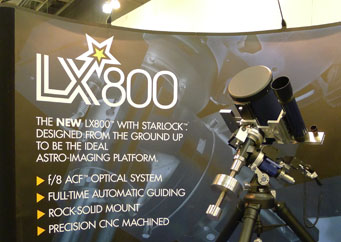
Of those, undoubtedly the most important are two new mounts from Meade Instruments: the LX-800 and the LX-80. The LX-800 is Meade's new platform for astrophotography. Its revolutionary feature is that it comes with a powerful integrated guidescope. No more searching around for a bright guide star, no more training your mount for better performance tracking the guidestar — just type in the name of your target and the telescope will slew there, automatically select an appropriate guide star, and start tracking with arcsecond accuracy. If that doesn't sound like a big deal to you, it's probably because you've never tried astrophotography and experienced firsthand how hard these things can be.
The LX-80 is the new automated Go To mount at the opposite end of the price spectrum. Its hallmark is versatility; it can run as an alt-az mount, a German equatorial mount, or a dual-scope mount, for a very affordable price.
S&T: Tony Flanders
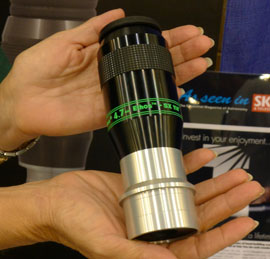
Tele Vue also announced an important new product: the 4.7-mm Ethos-SX eyepiece, the successor to the groundbreaking 3.7-mm Ethos-SX, with the same jaw-droppingly wide 110° apparent field of view. The field of view speaks for itself, but something that might not be obvious unless you've seen an Ethos-SX yourself is that the eyepiece works both in 1.25-inch and 2-inch focusers. The unit shown at right has the 2-inch adapter in place; screw it off and you find a 1.25-inch eyepiece underneath. The fit and finish are done with Tele Vue's signature attention to detail — something that's hard to appreciate until you've actually handled the eyepiece.
S&T: Tony Flanders
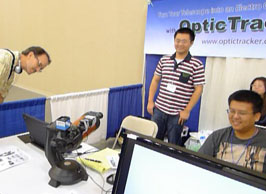
At every trade show, there's always something that takes me by surprise. Here, it's a new piece of integrated hardware and software called the Optic Tracker. It combines digital image processing and telescope control to allow your Go To scope to automatically track a moving target once you've centered it in the crosshairs. Originally designed for taking images and movies of satellites, it also works for airplanes, helicopters — and people. Watching a NexStar 4SE with a piggybacked webcam track the developer as he moved around in his booth was one of the most entertaining experiences I've had in a long time.
Sounds like a toy? Maybe. But my daughter, who loves to track airplanes with my 7-inch Dob, sure would love one. By the way, the company's website doesn't reveal how much this product costs until you try to buy one — I'll see if I can get them to fix that.

Comments
Andrew
September 23, 2011 at 8:49 am
Was fun. But wished there had been more vendors.
You must be logged in to post a comment.
kcops
September 23, 2011 at 3:42 pm
It has been getting smaller and smaller for the past 3 yrs. I suspect the bad economy is slowly killing PATS. Hope it survives as my friends and I enjoy the opportunity to see and touch products before we buy.
You must be logged in to post a comment.
You must be logged in to post a comment.