 SUNSET:

 16
16August is the best month overall to view meteors from the Northern Hemisphere, according to Robert Lunsford, operations manager of the American Meteor Society. And conditions are ideal this year because the Perseid meteor shower peaks on the new-Moon night of Sunday–Monday, August 12–13.
The Perseids are one of the two strongest and most reliable annual meteor showers. (The other is December's Geminids.) And while some showers produce brief bursts lasting just a few hours, the Perseids have a broad peak. So don't despair if clouds are forecast for Sunday night — or if work obligations prevent you from staying up until dawn on Monday. Even now, a week before the peak, you can see up to a dozen Perseids per hour if conditions are perfect. That's stronger than some meteor showers at their best!
The meteor rate increases to roughly 30 per hour in the predawn hours on Saturday, 45 per hour on Sunday morning, and 80 per hour before the sky starts to get light on Monday morning. That's for a single observer at a dark-sky site in the north temperate latitudes.
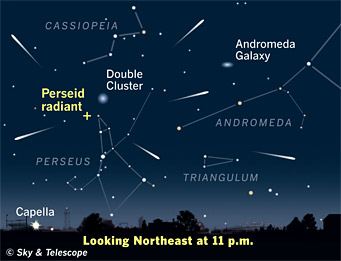
The Perseid meteors appear to stream away from their radiant near the border of Perseus and Cassiopeia. And while you're outside on a dark night, don't forget to look for the Double Cluster and the Andromeda Galaxy, two of the easiest "faint fuzzies" to spot with your unaided eyes.
S&T Illustration
Perseid meteors are visible in every part of the sky. But wherever you see them, they appear to be moving away from the shower's radiant point near the Perseus/Cassiopeia border. This is a perspective effect, happening for the same reason that snowflakes appear to stream away from the center of the road when you're driving through a snowstorm.
On any given night, activity starts slowly in the evening but picks up by 11 p.m., when the radiant gets reasonably high in the sky. The meteor rate increases steadily through the night as the radiant rises higher, peaking just before the sky starts to get light, roughly 1½ to 2 hours before sunrise.
For the most pleasant viewing experience, find a spot far from any city lights. Perseids tend to be relatively bright as meteors go, but you'll still see more the darker your skies are. Bring a reclining chair so that you can view high in the sky in comfort; there's no point in filling half your field of view with trees. Don't forget warm, mosquito-proof clothes or, better, a sleeping bag. No matter how hot the days are, it can get surprisingly chilly under a clear sky late at night, especially whan you're inactive. And for many people, the most important accessory is bug spray for the parts of you that remain exposed!
It doesn't really matter where in the sky you watch; meteors can appear anywhere. Just watch where it's darkest, usually straight up. It's probably best not to stare directly at the radiant, because meteors there leave short trails.
Keep track of the direction each meteor is moving. Though most will be Perseids, you'll probably see plenty of Delta Aquarids moving more or less in the opposite direction. And this time of year is also good for sporadic meteors not associated with any recognized shower.
More on meteors and how to observe them — including how to make a scientific count to report to the International Meteor Organization — is in our meteor section.




Comments
jaki
August 10, 2007 at 7:20 pm
Anyone know if we get much of a show in the Southern hemisphere particulary on the mid East coast of Australia?
If so where to look and what days are the best?
You must be logged in to post a comment.
-V
August 11, 2007 at 1:04 pm
I found info about "Observing the Perseids" in the Southern Hemisphere on the following site -
http://meteorshowersonline.com/perseids.html
You must be logged in to post a comment.
Mark
August 12, 2007 at 9:45 am
What are the chances of the shower lasting till next weekend?
You must be logged in to post a comment.
Boz
August 12, 2007 at 11:58 am
'Tain't seen nothin' yet through all the haze and heat here in Middle (the very heart of) Tennessee.
You must be logged in to post a comment.
tyray
August 12, 2007 at 2:45 pm
whitch direction from central ohio my son and i are looking to night august 12, 2007
You must be logged in to post a comment.
bk
August 12, 2007 at 6:09 pm
Saw quite a few last night out here in Arizona..look to the northeast.
You must be logged in to post a comment.
Rita Bronner
August 12, 2007 at 6:30 pm
I started veiwing last night in the desert arround 11pm. It was beautiful! I am heading back out tonight for the show in the desert. I am truely luckly to be in Las vegas in the desert for this shower. My first!
You must be logged in to post a comment.
kelli
August 12, 2007 at 9:08 pm
hello...last night was a beautiful display here in central ohio. luckily we live in the country and have a dark sky to view. we are on our way outside now to hopefully see an even more dramatic shower. happy gazing to all!
You must be logged in to post a comment.
Bonnie
August 12, 2007 at 11:51 pm
At 11:10 pm we heard a strange sound, at first I thought it was an airplane, but then it sounded crackly, we turned in time to see a brilliant fireball shoot from N to SW and explode like a small fireworks display! The trail glowed bluish white for about 1/2 minute! The most spectacular display I've seen in several years! (Michigan)
You must be logged in to post a comment.
Bonnie
August 12, 2007 at 11:51 pm
At 11:10 pm we heard a strange sound, at first I thought it was an airplane, but then it sounded crackly, we turned in time to see a brilliant fireball shoot from N to SW and explode like a small fireworks display! The trail glowed bluish white for about 1/2 minute! The most spectacular display I've seen in several years! (Michigan)
You must be logged in to post a comment.
Pamette Balda
August 13, 2007 at 12:04 am
We are seeing several displays of shooting lights in the sky here in Illinois tonight.
You must be logged in to post a comment.
natalie
August 13, 2007 at 12:51 am
We spent three nights camping in Yosemite N. P., (Mon.-Wed.) at around 8,000 feet. It was a little early for the full thrust of the Perseids, but the sky was spectacular. We saw plenty of meteors! Cold, clear skies, plenty of privacy and only one persistent bear!
You must be logged in to post a comment.
Felix
August 13, 2007 at 2:55 am
72 meteorites an hour! Not in Bastrop Texas, not a one.
I traveled from Austin to Bastrop to escape the city lights.
I set up my Meade ETX-125 and two cameras on the Meade DSX-90 mount, one SLR and one digital.
I viewed from about 11:15 PM to right at 2:00 AM local time. The skies were clear at first but some clouds rolled in for a few minutes and then rolled out.
I visually scanned the dark skies with my eyes and not one chunk of rock burned up in the atmosphere the whole time.
There were more fireflies this year than past years and the moosquitos were hungry.
I then packed all the gear and drove back to Austin thinking I would see a streak across the sky but I did not.
This event was advertised to be more than what it was.
I can't wait for the polar shift that is to come.
Goodnight.
You must be logged in to post a comment.
Giogio
August 13, 2007 at 4:33 am
The starry sky was glorious.
The perspective was magnificent.
The occurrence was never frequent enough.
The angel was affectionate.
The baby was blessed.
The memory is cherished.
You must be logged in to post a comment.
heather
August 13, 2007 at 2:40 pm
i seen three meteors on sunday night and 17 on saturday night. southern illinois
You must be logged in to post a comment.
Mark
August 15, 2007 at 9:45 am
Im up in Toronto and i was able to catch about 7 in 30 min on sunday...was pretty cool.
Going further notrh this weekend..so hopefully theres some reminents left over.
You must be logged in to post a comment.
You must be logged in to post a comment.