 SUNSET:

 0
0Whatever its phase, the magnificent Moon has a lot to offer when viewed with a telescope.
Night Sky illustration
Some stargazers find the Moon an annoyance; its brightness makes it difficult to view faint nebulae, galaxies, and other "deep-sky" objects. But for me the Moon is forever an enchanted land, readily available even under less-than-ideal sky conditions. Whether presenting itself as a razor-thin slice or a circular orb lighting the night sky, the Moon always offers a visual feast. The interplay of shadows among the towering peaks and craters will appeal to your aesthetic interests and feed your curiosity. And its proximity allows even the most basic of astronomical instruments, the unaided eye, to explore some of the more prominent features.
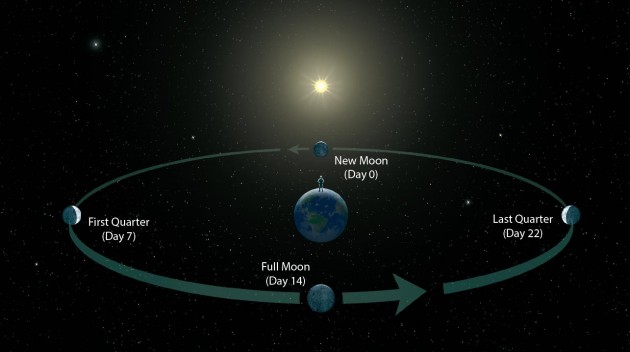
Every 29½ days, as the Moon glides in its orbit around Earth, it steps through a complete cycle of its phases — from delicate crescent to fat disk and back again. Our month-long tour begins shortly after new Moon, which astronomers count as "Day 0" of the lunar month, and continues through first quarter (Day 7), full Moon (Day 14), and last quarter (Day 22). I've picked times when some of my favorite lunar features are prominently positioned near the terminator, the border between lunar day and night, where a low-angle Sun creates dramatic shadows that help define the shapes of craters and mountains and gives them a three-dimensional appearance.
Days 3 and 4
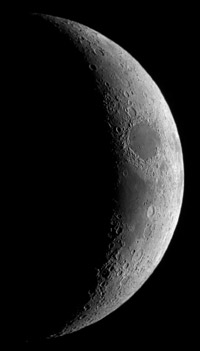
Few astronomical sights are more beautiful than a crescent Moon lingering in the evening twilight. The Moon is now waxing, or growing more fully illuminated, night by night. You'll often see a faint glow on the unlit side of the disk, next to the crescent. Sometimes called "the old Moon in the new Moon's arms," this Earthshine is sunlight that has been reflected onto the lunar landscape by Earth and has bounced yet again back toward us. Under the right conditions, you might even be able to identify prominent lunar features within the area lit up by earthshine.
One of the most obvious features on the waxing crescent is Mare Crisium (Latin for "Sea of Crises"), an oval dark spot north of the lunar equator that's about 350 miles across. (It's just above center in the image at right.) I like to check Mare Crisium with each new lunar cycle. If you keep a close eye on it from month to month — or even over a few nights' time — you'll find that Mare Crisium moves toward or away from the edge of the lunar disk. Sometimes it's very close and appears more elongated than at other times. You can monitor this phenomenon with the unaided eye. This slight nodding of the disk, called libration, results from the not-quite-constant velocity of the Moon in its orbit and other geometrical factors.
Days 5 and 6
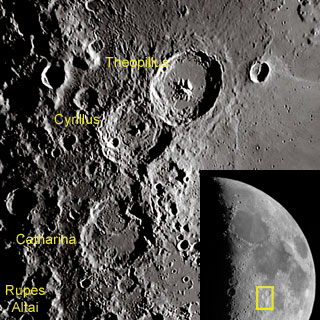
Three prominent craters straddle the terminator on Day 5 — and they can be seen easily with binoculars. The first, Theophilus, is a 60-mile-wide ring that borders the shore of Mare Nectaris (Sea of Nectar). Through a telescope magnifying at about 80×, you should see a long, narrow shadow cast by the 4,600-foot-high cluster of mountain peaks at Theophilus's center. I like to use high power to try to distinguish individual peaks and explore the terraced inner walls of the crater.
Equal in size is the adjoining crater, Cyrillus. It's also ring-shaped, though part of its circumference has been breached by Theophilus. Tonight's shadows outline its rim, which to me appears slightly elongated in a north-south direction. The nearby crater Catharina is like-sized, but it lacks a central peak and its walls have partly disintegrated. Look for the mountain range Rupes Altai as it passes near Catharina's rim.
Day 8
Some moongazers consider the date of first-quarter Moon (Day 7) to offer the most impressive lunar vistas. But waiting just one day later brings sunlight onto a few more dramatic features.
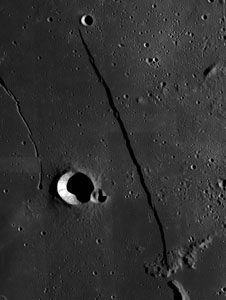
For example, Rupes Recta, the "Straight Wall," is 800 to 1,000 feet high. It's an easy find for a small telescope — look south-southeast of the prominent crater Ptolemaeus, which lies to the right of the terminator near the center of the Moon. Although the Straight Wall might look like a steep cliff, it has a slope of only about 15°. Tonight this 80-mile-long feature appears as a thin, dark line — but 15 days from now it will look very different.
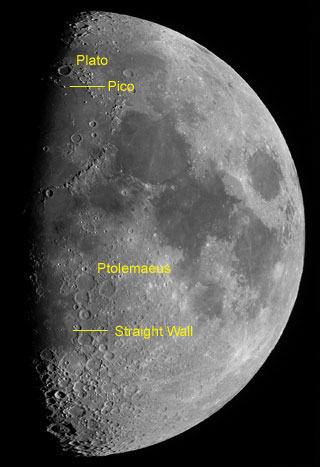
Now sweep to the northern edge of Mare Imbrium (Sea of Rains), where you'll find Plato. This 60-mile-wide crater, sometimes likened to a "walled plain," has no central peak and a lava-filled floor that appears darker than its surroundings. It's truly circular, but it looks like an oval because of foreshortening at that far-northern latitude. In my 8-inch-aperture telescope at low power (40×), I see one wall cast in shadow and the opposite wall brightly lit. Try increasing the power to see if you can locate tiny craterlets on Plato's floor.
Just to the south lies Pico, a solitary mountain roughly 10 by 15 miles in breadth that abruptly rises 7,900 feet above the surrounding terrain. The slopes aren't really all that steep, but at this time of the lunar cycle I see a long slender shadow cast by Pico, which gives me the impression of a towering mountain. Some observers think it looks like a cathedral spire. What does it look like to you?
Day 9
Prominently splashed across the eastern half of Oceanus Procellarum (Ocean of Storms) is one of the Moon's grandest features. Copernicus, a spectacular 58-mile-wide crater, is distinguished by deeply terraced ramparts that rise 3,000 feet above the surrounding plain. The crater's interior has a broad, relatively flat floor with conspicuous central mountains.
Day 12

Damian Peach
The Moon's disk is now gibbous, a rounded shape seen for several days before or after full Moon.
Tucked inside the northern side of Mare Humorum (Sea of Moisture) is the prominent flooded crater Gassendi. It spans almost 70 miles, has walls rising to 6,100 feet, and contains a number of central peaks. The central peaks are evident, but Gassendi has a gap in its southern wall, where the shadows go from black to light gray. A network of clefts, seen as thin streaks under high power, crisscrosses the crater floor. Some of these may be challenging to spot, depending on the size of your telescope and the steadiness of the atmosphere. Jutting into the northern rim is the craterlet Gassendi A. It's about a third the size of the main depression, yet its walls are almost twice as high. And while in the area, don't overlook the spectacular set of raised rilles that run across Mare Humorum's broad floor, on the side opposite Gassendi.
Full Moon (Day 14)
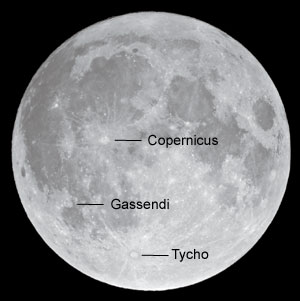
When the Moon is bright and full, I find binoculars to be ideal for studying the rays that spray out like bright spokes from prominent lunar craters. Near the southern limb is Tycho, a 53-mile-wide crater that's the hub of the Moon's best ray system. Another set radiates from Copernicus. See if you can detect these ray systems with your eyes alone.
Because of the lack of shadows during a full Moon, it's a challenge trying to identify features that a few days ago were near the terminator, when shadows helped define their shape. However, the straight-on sunlight makes it possible to observe other characteristics in the landscape particularly well. For example, darker shadings become apparent in the maria — variations that are due to differing ages and compositions among these ancient volcanic flows. To me Tranquillitatis looks darker overall during full Moon than other maria do, and the eastern and southern shores of Serenitatis look darker than its interior. Check for yourself.
Day 20
The illuminated portion of the Moon has been waning (growing smaller) for several days now. During lunar sunset, Maurolycus, a large crater found in the rugged southern highlands, has an almost abstract appearance when seen in a telescope at low power. I'm struck by the central peak's shadow, which looks like a clock hand that nearly touches the outer edge of this 70-mile-wide depression. The crater walls, which in places soar 15,000 feet above the floor, are outlined in black.
Day 22
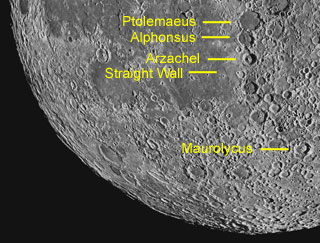
Many of the features seen in dramatic relief at first quarter are again visible along the terminator, except that the direction of sunlight has flipped. Northeast of Mare Nubium, the crater Ptolemaeus exhibits a hexagonal shape 95 miles across. Its stark walls are outlined in white, with shadows filling in the crater Herschel to its north. Here's a good place to crank up the power on your telescope and search the floor of Ptolemaeus for small craterlets. Attached at its southern lip is the crater Alphonsus, which displays a 3,800-foot-high central peak and walls that rise to twice that height. South of Alphonsus is another bold crater, Arzachel, with even higher ramparts. The interplay of light and dark creates a fascinating display — the central peak's shadow extends for half the crater's 60-mile diameter.
In between Alphonsus and Arzachel, and less than half as big, look for Alpetragius. If you catch the sunlight just right, you'll see a half-dark interior sporting a white-tipped peak.
Day 23
By now the Moon doesn't rise until after midnight — so to do some lunar gazing you'll either have to stay up late or get up early. But it's worth it: if you're like me, you'll never get tired of seeing Rupes Recta, the Straight Wall. Tonight look for the thin white line of sunlight reflecting off its slope.
NASA / GSFC / Arizona State Univ.
The Moon offers stunning views like these every night as the terminator sweeps across the lunar landscape twice every month. I could only touch on some of my favorites here; you'll find others labeled on the map above. You should also check out Alan MacRobert's guided tour of some of his favorite targets.
One thing's for sure: The Moon will seem different every time you look.

Comments
You must be logged in to post a comment.