 SUNSET:

 0
0Contacts:
J. Kelly Beatty, Executive Editor
855-638-5388 x148, [email protected]
Alan MacRobert, Senior Editor
855-638-5388 x151, [email protected]
Note to Editors/Producers: This release is accompanied by high-quality graphics and an animation; see end of release.
For more information, including tips on how to photograph the eclipse, please direct your readers/viewers to http://SkyandTelescope.com/MarchEclipse.
Lucky skywatchers will witness a total lunar eclipse on Saturday evening, March 3, 2007. However, where you live will dictate whether you'll get to enjoy this grand celestial spectacle — or watch the full Moon rise after it's all over.
In the U.S. and Canada, the eclipse strongly favors those east of the Mississippi River, who'll see the Moon completely engulfed by Earth's shadow as night falls. Farther west, the Moon is only partly in shadow by the time it rises (at sunset). Unfortunately, for anyone west of the Rockies, even the event's partial phase ends before moonrise.
Only in New England, Québec, and the Maritime Provinces does the sky become fully dark with the Moon still totally eclipsed. Farther east, the entire eclipse can be viewed from Europe, Africa, and western Asia, where it occurs late at night or before dawn on March 4th.
Here are the key event times for the eclipse, given for five North American time zones. Compare these with your times of sunset and moonrise, which depend on your location (dashes: event not visible):
| Total Eclipse of the Moon — March 3, 2007 | |||||
| Eclipse stage | AST | EST | CST | MST | PST |
| Partial eclipse begins | 5:30 p.m. | — | — | — | — |
| Total eclipse begins | 6:44 p.m. | 5:44 p.m. | — | — | — |
| Total eclipse ends | 7:58 p.m. | 6:58 p.m. | 5:58 p.m. | — | — |
| Partial eclipse ends | 9:12 p.m. | 8:12 p.m. | 7:12 p.m. | 6:12 p.m. | — |
| Last shading visible? | 9:50 p.m. | 8:50 p.m. | 7:50 p.m. | 6:50 p.m. | — |
A total lunar eclipse occurs when the Sun, Earth, and Moon form a nearly straight line in space, so that the full Moon passes through Earth's shadow. Unlike a solar eclipse, which requires special equipment to observe safely, you can watch a lunar eclipse with your unaided eyes. Binoculars or a telescope will enhance the view dramatically.
The outer part of Earth's shadow, called the penumbra, creates only a slight dusky shading on the lunar disk. But as the Moon begins to move into the central and darkest part of Earth's shadow, the umbra, there's an obvious and ever-larger "bite" in the full Moon. The partial eclipse is then under way.
The total eclipse begins when the Moon is fully within the umbra. On March 3rd, totality lasts 1 hour 14 minutes. But the Moon likely won't disappear completely. It usually glows as an eerie, coppery red disk in the sky, as sunlight scattered around the edge of our atmosphere paints the lunar surface with a warm glow. This is light from all the sunrises and sunsets that are in progress around Earth at the time.
It's been 2½ years since the last total lunar eclipse, on October 27, 2004. The next one, on August 28, 2007, will favor skywatchers in western North America over those in the east.
Sky & Telescope is making the following illustrations, photographs, and animation available to editors and producers. Permission is granted for one-time, nonexclusive use in print and broadcast media, as long as appropriate credits (as noted in each caption) are included. Web publication must include a link to SkyandTelescope.com.
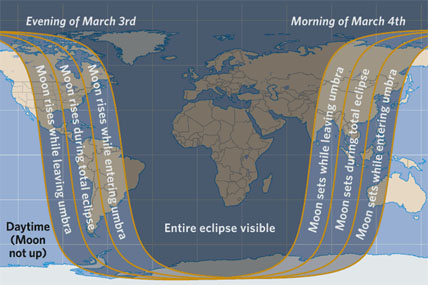
The eclipse of March 3rd will be nearing its end when the Moon rises over most of North America. Only in New England, Québec, and the Maritime Provinces will the sky be fully dark before the end of totality. Click on the image for a larger version.
Sky & Telescope illustration by Gregg Dinderman
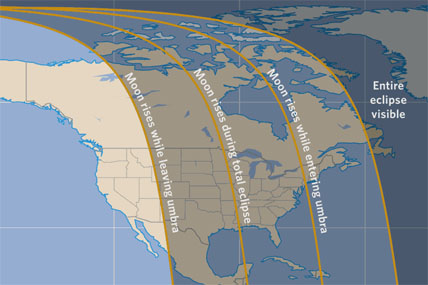
The eclipse of March 3rd will be nearing its end when the Moon rises over most of North America — only in New England, Québec, and the Maritime Provinces will the sky be fully dark before the end of totality. However, skywatchers in Europe, Africa, and western Asia will see the entire eclipse in the predawn hours of March 4th. Click on the image for a larger version.
Sky & Telescope illustration by Gregg Dinderman
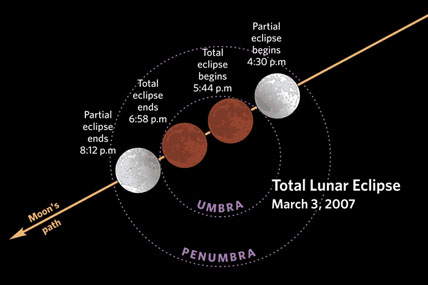
The eclipse of March 3rd will be nearing its end when the Moon rises over most of North America. Only in New England, Québec, and the Maritime Provinces will the sky be fully dark before the end of totality. (Note: Labels are in Eastern Standard Time.) Click on the image for a larger version. Click here for a version without labels.
Sky & Telescope illustration by Gregg Dinderman
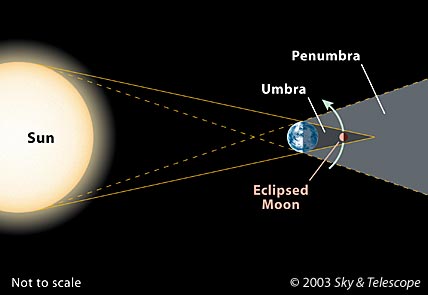
A lunar eclipse occurs when the Moon passes through the shadow cast by the sunlit Earth. When the Moon enters the outer penumbra, where just part of the Sun's light is blocked, it becomes only slightly dimmer. Only when it passes into the shadow’s core, the umbra, does it look markedly darker. This illustration is available as a publication-quality JPEG (399 kilobytes); it is also available without labels (344 kilobytes).
Sky & Telescope illustration by Gregg Dinderman.
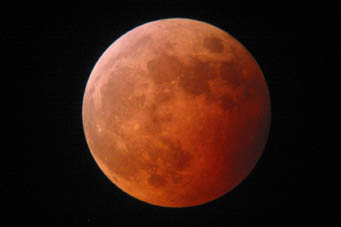
Taking a break from Game 4 of the World Series on October 27, 2004, Sky & Telescope editor in chief Rick Fienberg snapped this view of that evening's total eclipse of the Moon. Click on the image for a larger version.
Sky & Telescope photograph by Richard Tresch Fienberg.
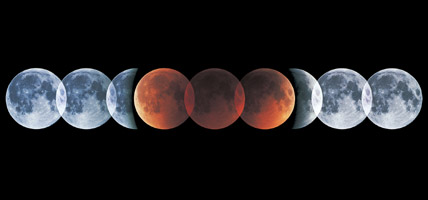
Aligning his camera on the same star for nine successive exposures, Sky & Telescope contributing photographer Akira Fujii captured this record of the Moon’s progress dead center through the Earth’s shadow in July 2000. This image is available as a publication-quality JPEG (1.5 megabytes).
Courtesy Akira Fujii and Sky & Telescope.
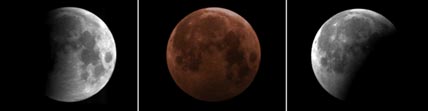
In this sequence of 291 images taken during a total lunar eclipse on September 27, 1996, 1 second represents 30 minutes of elapsed time. Coloring has been added to simulate the Moon's appearance when it was completely within Earth's shadow; the totally eclipsed Moon has been brightened for clarity. During totality, dark, murky blobs are seen crossing the lunar disk — an effect caused by variations in the tiny amount of sunlight that leaks onto the Moon after being refracted (bent) through Earth's atmosphere. This animation can be viewed or downloaded as a broadcast-quality (3.7-megabyte) QuickTime animation.
Sky & Telescope animation by Craig M. Utter and Gregg Dinderman; images courtesy António Cidadão.
Sky Publishing (a New Track Media company) was founded in 1941 by Charles A. Federer Jr. and Helen Spence Federer, the original editors of Sky & Telescope magazine. In addition to Sky & Telescope and SkyandTelescope.com, the company publishes two annuals (Beautiful Universe and SkyWatch), as well as books, star atlases, posters, prints, globes, and other fine astronomy products.



Comments
You must be logged in to post a comment.