 SUNSET:

 4
4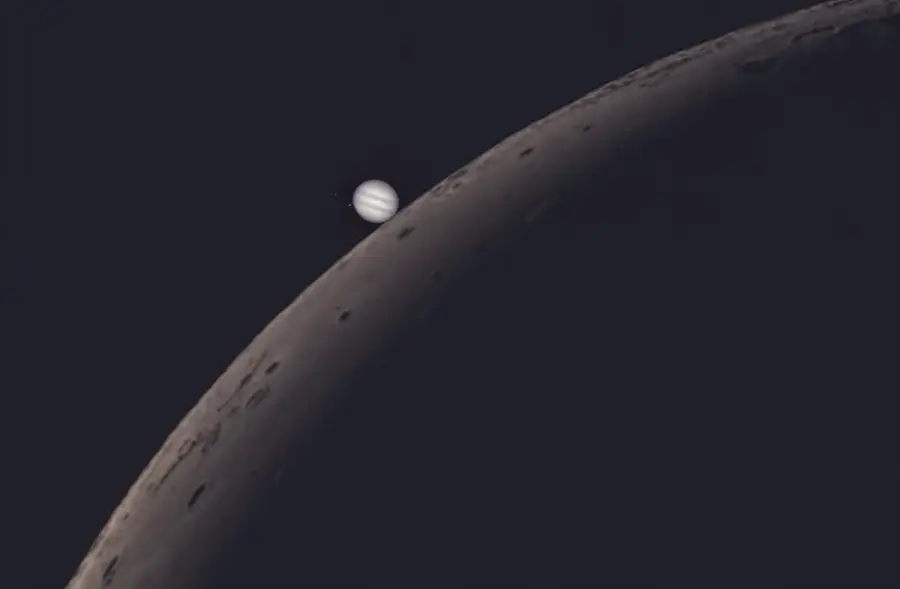
Chi Rho Scenic Photography
I'm so pumped for this: During the early morning hours of Tuesday, October 6th, the thick, waning crescent Moon will hide the giant planet Jupiter and its four brightest moons. That makes it a quintuple occultation! According to Joe Rao, meteorologist and contributing editor for Sky & Telescope, Jupiter occultations occur on average about every 13 years for a particular location. I don't recall ever seeing the Moon cover Jupiter, so it will be a personal first, weather permitting.
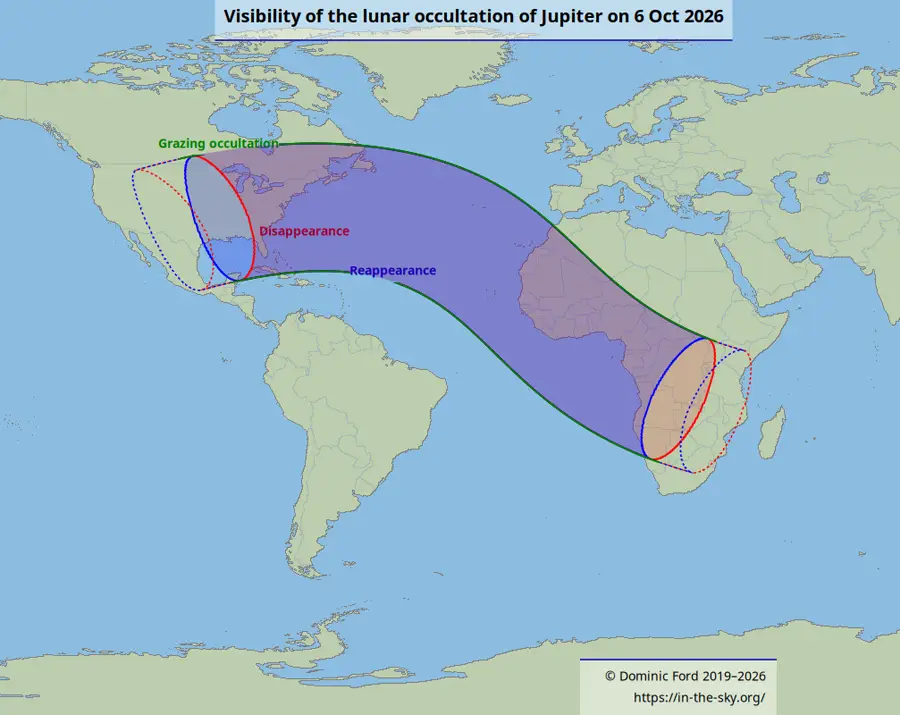
Courtesy of Dominic Ford, in-the-sky.org
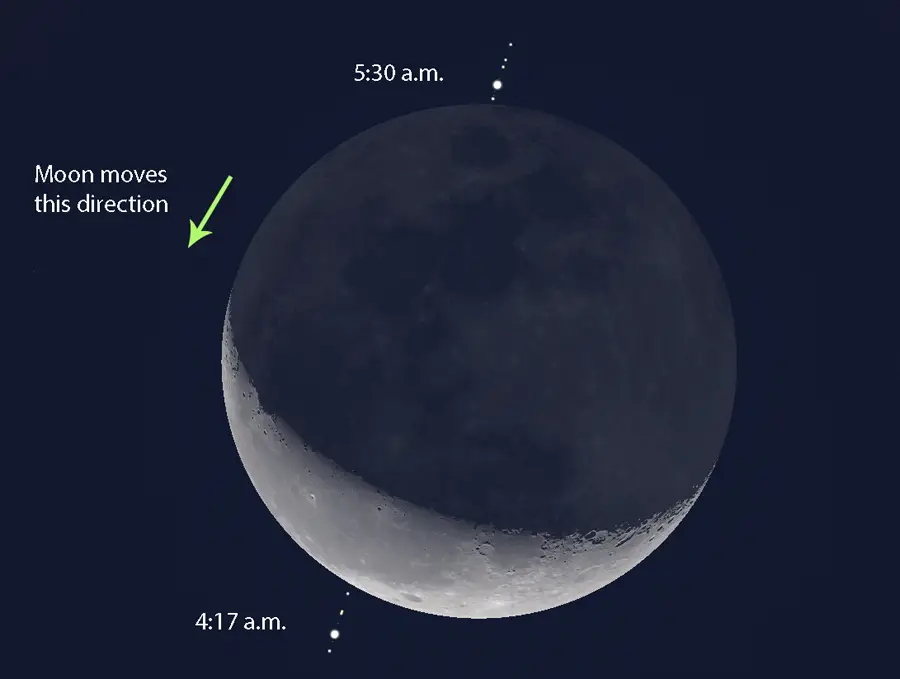
Occultations are the ultimate conjunctions. Instead of two bodies in a near-miss scenario, one completely covers the other. If you like rooting for the underdog, you'll enjoy watching an orb a mere 3,500 kilometers (2,160 miles) across temporarily nix a planet 11 times wider than Earth. The entire occultation — from Jupiter's disappearance at the Moon's bright limb to its emergence at the dark limb — occurs just before dawn for much of the eastern half of North America. In the mountain states, only the reappearance (the best part anyway) will be visible. Given Jupiter's apparent diameter of 33.7″, it will take the Moon about 60-70 seconds to cover Jupiter and a similar time to uncover it.
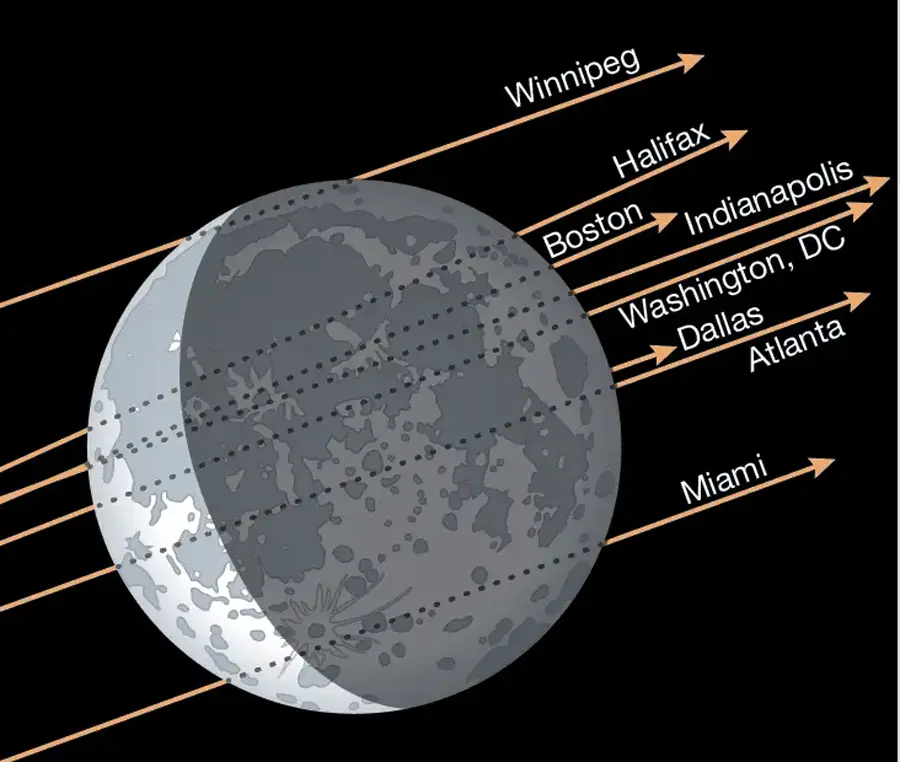
S&T illustration, Source: Eberhard Riedel / IOTA
Face east, look low
From many places, the Moon will be low in the sky. Be sure to find a spot with a wide-open vista to the east so trees and buildings don't block the view. From Boston in New England, where circumstances are best, the Moon's altitude will be 23° at occultation start. Farther west, it's closer to the horizon — in Kansas City, Mo. the duo stands just 4° high at the start. Observers in the mountain states will miss the first half of the occultation but see Jupiter reborn at the dark limb with the Moon only a few degrees above the horizon.
In the Pacific Time Zone, skywatchers will witness a fantastic conjunction, with Jupiter and the Galilean moons hovering mere arc-minutes above the earth-lit lunar limb at moonrise. Photographers will seize the opportunity to capture a colorful and misshaped Moon flattened by atmospheric refraction.
| City | Jupiter disappearance | Jupiter reappearance | Ingress/egress duration |
| Halifax | 5:35:02 a.m. | 6:36:10 a.m. | 73 seconds / 80 sec. |
| Boston | 4:26:45 | 5:29:55 | 69 sec. / 73 sec. |
| Washington, D.C. | 4:20:32 | 5:24:29 | 63 sec. / 68 sec. |
| Miami | 4:20:48 | 5:09:02 | 82 sec. / 89 sec. |
| Atlanta | 4:15:41 | 5:16:42 | 62 sec. / 67 sec. |
| Indianapolis | 4:19:31 | 5:18:06 | 62 sec. / 66 sec. |
| Chicago | 3:22:14 | 4:17:23 | 65 sec. / 69 sec. |
| New Orleans | 3:14:26 | 4:11:03 | 60 sec. / 65 sec. |
| Kansas City, Mo. | 3:19:42 | 4:14:05 | 61 sec. / 66 sec. |
| Denver | ----- | 3:11:08 | 64 sec. (egress) |
| Salt Lake City | ----- | 3:09:28 | 71 sec. (egress) |
| Helena | ----- | 3:01:13 | 175 sec. (egress) |
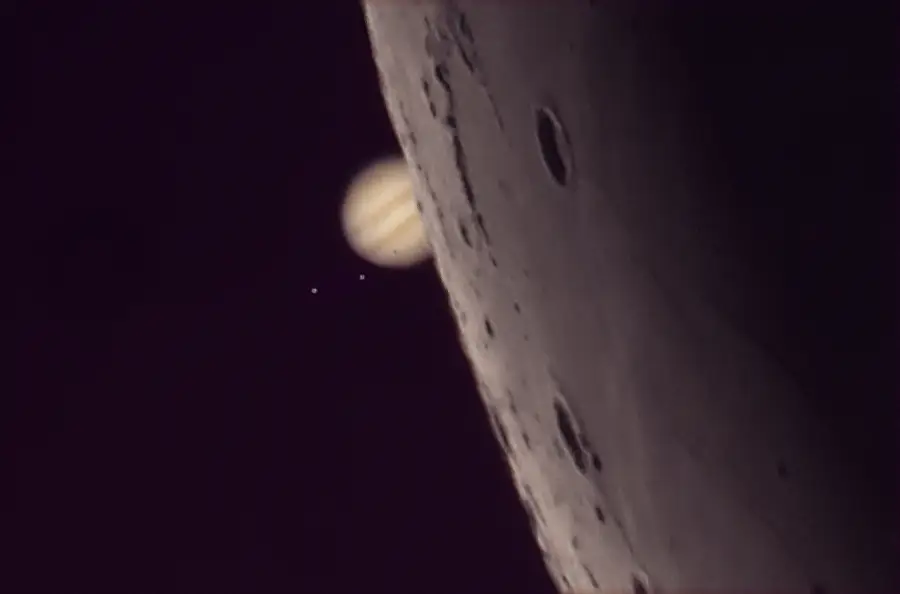
Donald W. Capone II
To find times when Jupiter is covered and uncovered for your location, check the extensive city listing at the International Occultation Timing Association's special event site. Times shown there are Universal Time (UT). Subtract 4 hours to convert to Eastern Daylight, 5 for CDT, 6 for MDT, and 7 for PDT.
Occultation culmination
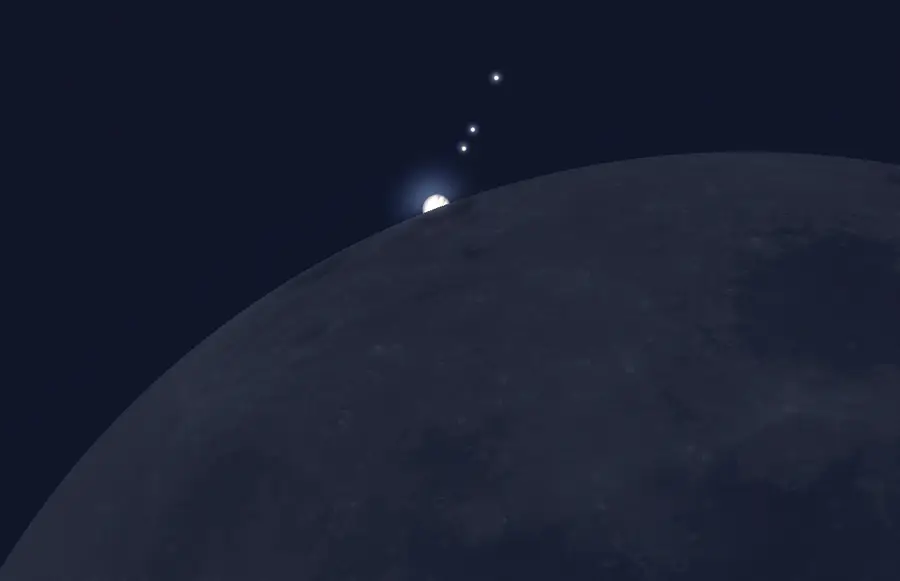
As the bright lunar limb approaches Jupiter just prior to occultation, the planet may become difficult to see without optical aid due to the Moon's glare. If that becomes a problem, use binoculars. But the real climax of the event, and the reason to get this event on your calendar, is the planet's climactic reappearance at the Moon's dark limb. Watching Jupiter (magnitude –1.9) swell from a tiny spark to full brilliance as the Moon slowly uncovers it may be one of the most majestic sights you'll ever witness. Once the gas giant is finally free of the Moon, it gleams triumphantly atop the crescent in the approaching dawn.
Stellarium
Earlier, I alluded to the four Galilean moons. They're all queued up and ready as appetizers before the main meal. All you'll need is a small telescope to see them. The first to disappear is Europa — roughly 5 minutes before Jupiter — followed by Callisto, Io, then big daddy Jove, and finishing with Ganymede. Given that the moons are all about 6th magnitude, they won't be easy to see at disappearance. Fortunately, they'll be obvious at reappearance along the dark limb, where quartet members rise one after another in succession. Given that each is a tiny disk, they won't flash into view instantaneously like stars do. For example, Ganymede, with a diameter of 1.2″, takes about 3 seconds to fully separate from the Moon.
Stellarium with additions by Bob King
Want to make sure you see the event? Use a weather app like Windy.com (click the satellite icon) and Zoom Earth to monitor where the clouds are and where they're going. Then be prepared to drive to a clear sky. Good luck and please share your reports and photos with us!

Comments
Scorpius
October 6, 2026 at 10:46 am
I was able to witness this spectacular event from Egg Harbor Township, NJ. My brother also came out and caught the reappearance. We used my Celestron C8, which is 36 years old and in excellent condition! We got up at 4, did our observing, and went back to sleep at around 5:45. It was well worth it and can't wait for the next occultation.
You must be logged in to post a comment.
Bob KingPost Author
October 9, 2026 at 11:39 am
Hi Scorpius,
Thank you very much for your report, and I'm happy you both were able to see it. Those old C8s rock!
You must be logged in to post a comment.
Anthony-Mallama
October 6, 2026 at 1:58 pm
That was a beautiful event. I especially enjoyed seeing satellites egress from the Moon’s dark limb before Jupiter reappeared.
You must be logged in to post a comment.
Bob KingPost Author
October 9, 2026 at 11:38 am
I agree, Anthony. One of my favorite moments was seeing Europa — first in line — reappearing at the dark limb. I was able to watch Jupiter approach the bright limb up to 4 minutes before occultation and follow it all the way with binoculars.
You must be logged in to post a comment.
You must be logged in to post a comment.