 SUNSET:

 0
0Update on Supernova 2026aaiv in NGC 7331: It's slowly fading. It was magnitude 12.2 at its brightest from September 16th through 19th. By the night of October 1-2 it was down to 12.9, according to observations reported to the American Association of Variable Star Observers. See Bob King's Second Bright Supernova in NGC 7331 in a Year, with chart.
FRIDAY, OCTOBER 2
■ Now that the evening sky is moonless, we're in a special time of year for the Milky Way under a dark sky. The Cygnus Star Cloud, one of the Milky Way's richest areas, crosses straight overhead around 9 p.m. When it does, the whole great mottled band runs straight up from Sagittarius low in the south-southwest, through Scutum and Aquila to Cygnus at the zenith, then straight down through Cepheus, Cassiopeia, Auriga, and Perseus to the north-northeast horizon. A perfect world-arch, and you're directly under it.
■ Algol should be at its minimum brightness for about two hours centered on 9:33 p.m. EDT. It takes several hours to fade and rebrighten.

On this chart, north us up. On the sky, celestial north is always the direction toward Polaris. Orient the chart accordingly when you're outdoors at night facing Perseus. It's high in the east-northeast these evenings.
■ Last-quarter Moon tonight (exact at 9:25 a.m. Saturday morning October 3rd). The Moon rises in the east-northeast around 11 p.m., about two fists below Capella.
SATURDAY, OCTOBER 3
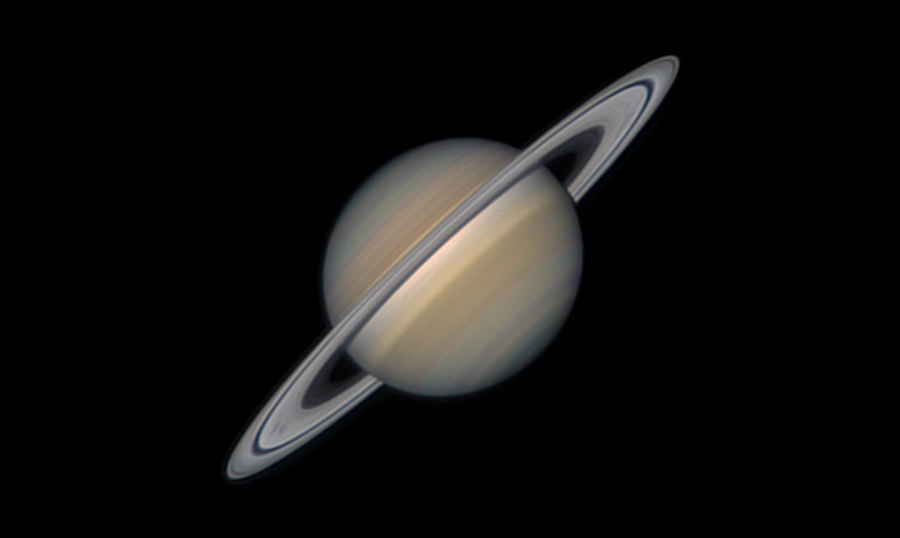
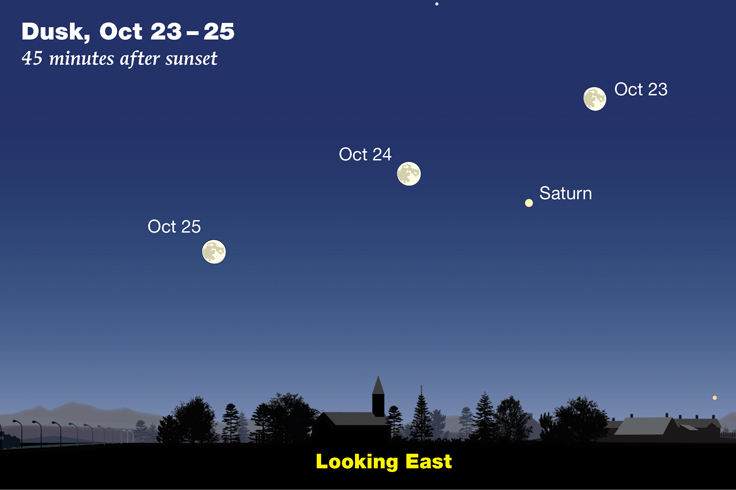
■ Saturn is at opposition tonight, opposite the Sun as seen from Earth. It rises at sunset, is highest in the middle of the night, and sets at sunrise. The Seeliger effect brightening Saturn's rings should be at its strongest tonight, growing and fading for a few days before and after.
The exact hour of opposition is 12h UT Oct. 4th (8 a.m. EDT Oct. 4th). For the Americas, this means Saturn is closest to opposition when observable high in darkness on the night of October 3-4. For much more, see Bob King's Saturn Flaunts its Rings at Opposition.
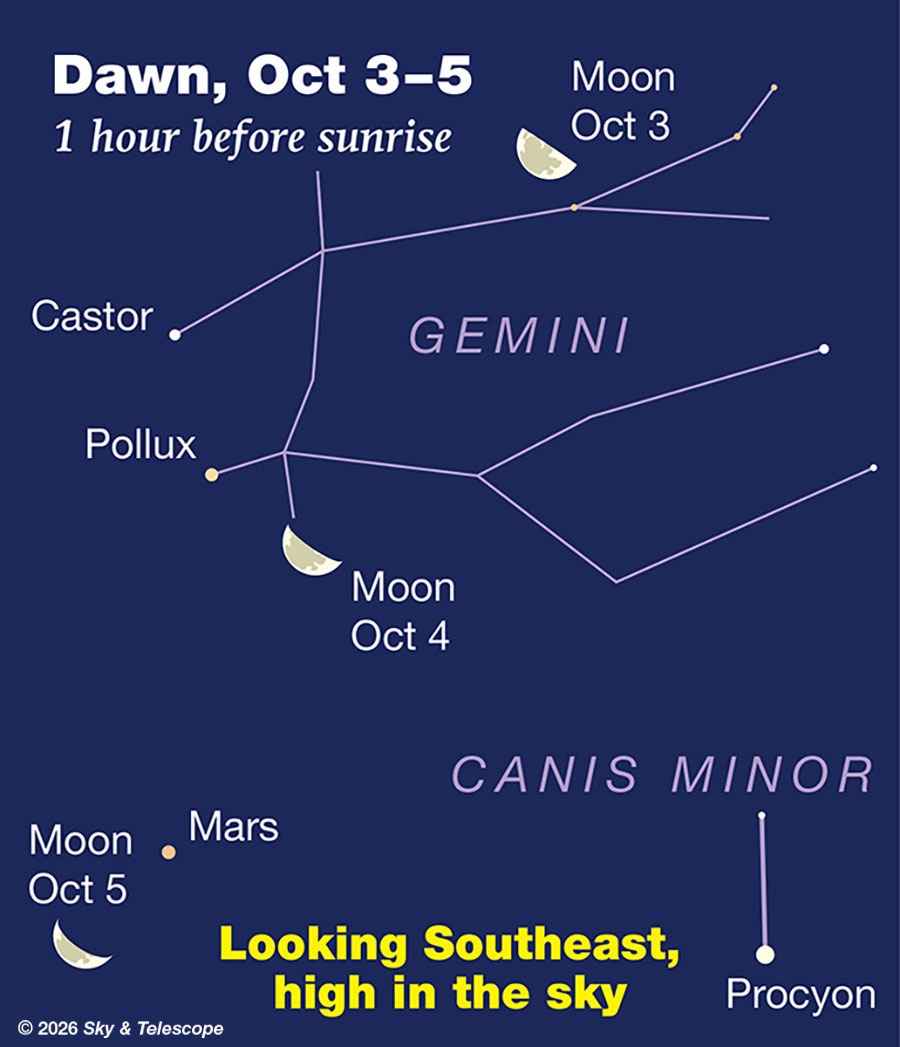
■ The waning Moon, just past last quarter, rises around midnight daylight-saving time. It climbs higher through the early morning hours of October 4th accompanied by Pollux and Castor, as shown below. Mars follows behind them once it rises about an hour after moonrise. An hour and a half after Mars-rise, up comes much brighter Jupiter. By the beginning of dawn on Sunday the 4th, they're all arrayed in a rough vertical line high in the east.
SUNDAY, OCTOBER 4
■ Vega is the brightest star very high in the west at nightfall. Arcturus, equally bright, is getting low in the west-northwest. The brightest star in the vast expanse between them, about a third of the way from Arcturus up toward Vega, is Alphecca, magnitude 2.2 — the crown jewel of Corona Borealis. Alphecca is a 17-day eclipsing binary, but its brightness dips are too slight for the eye to see reliably.
■ Before dawn begins on Monday the 5th, the Moon hangs between Mars above it and Jupiter farther below it. Binoculars can reveal the Beehive Cluster, M44, quite near the Moon (for the Americas).
MONDAY, OCTOBER 5
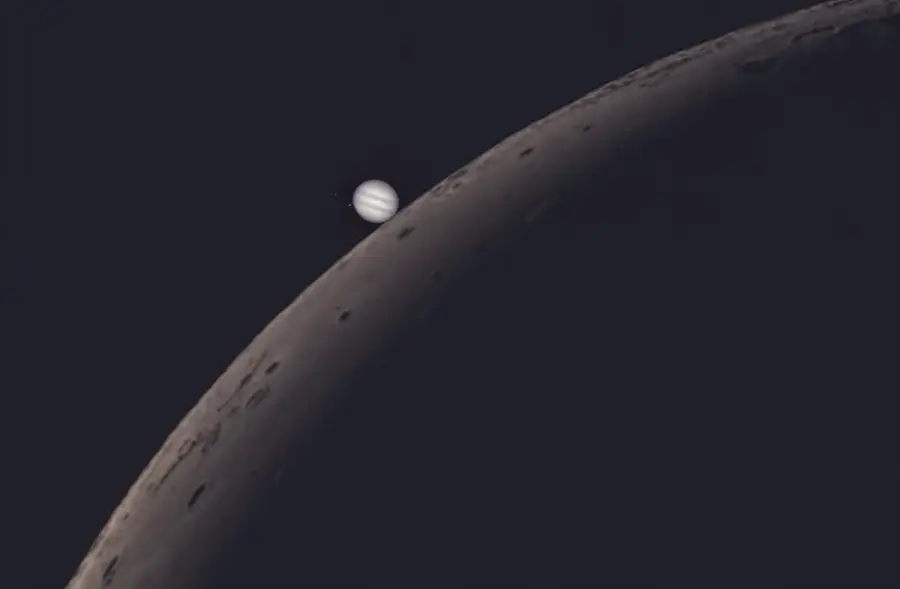
■ The Moon occults Jupiter very late tonight for observers in eastern and central North America and parts of the mountain region, and for much of Africa. The occultation will start as the Moon's bright limb slowly covers the planet. Notice how much dimmer Jupiter's surface brightness is compared with the Moon's. That's due to Jupiter's five-times-greater distance from the illuminating Sun. Jupiter will reappear out from behind the Moon's dark limb up to an hour or more later. See the article in the October Sky & Telescope, page 48, and Bob King's Watch the Moon Occult Jupiter Early October 6th.
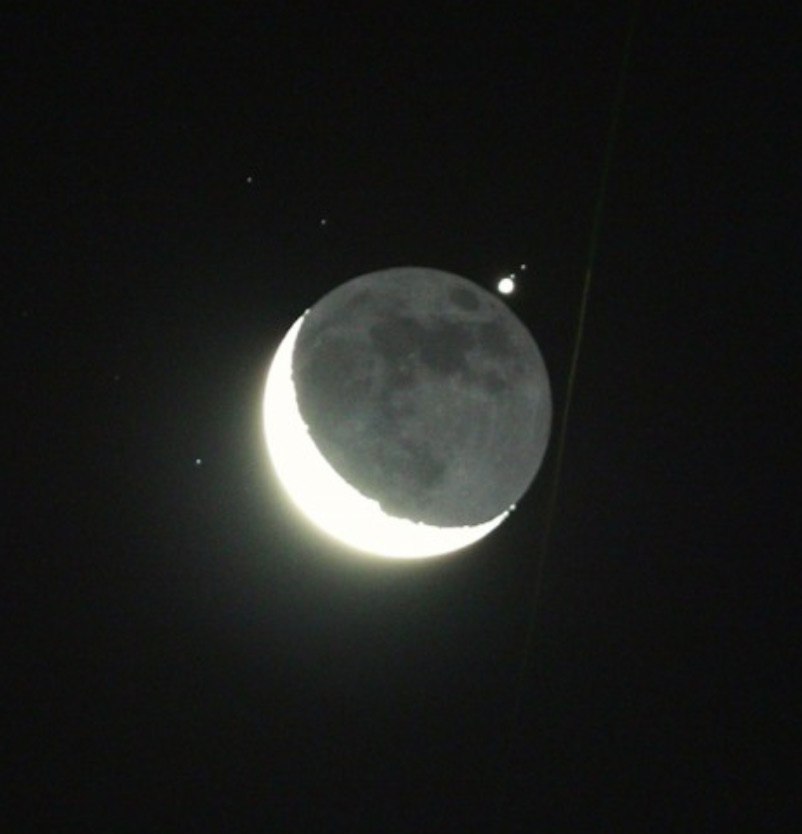
World map and timetables for the occultation. The first two tables, with predictions for many cities, are long. The first table gives the times of the start of Jupiter's disappearance behind the Moon's bright limb; the second gives its reappearance out from behind the dark limb. Scroll to be sure you're using the correct table; watch for the new heading as you scroll down. The first two letters in each entry are the country abbreviation (CA is Canada, not California). The times are in UT (GMT) October 6th. UT is 4 hours ahead of Eastern Daylight Time, 5 hours ahead of CDT, 6 ahead of MDT, and 7 ahead of PDT.
For instance: Use the first table to see that for New York City, Jupiter begins to slip behind the Moon's bright edge at 4:23 a.m. EDT October 6th, when the Moon will be 20° high almost due east (azimuth 87°). Jupiter starts re-emerging from behind the dark limb at 5:27 a.m. EDT, when the Moon will be 27° up.
TUESDAY, OCTOBER 6
■ Vega is the brightest star very high when you face west. While still facing west, look to the right of Vega by 14° (a little more than a fist at arm's length) for Eltanin, the 2nd-magnitude nose of Draco the Dragon. It's tinted orange. The rest of Draco's fainter, lozenge-shaped head is a little farther right. Draco always eyes Vega as they wheel around the sky.
Farther on, behind Draco's head, his long, arched back and tail loop around the Little Dipper.
The main stars of Vega's own constellation, Lyra — faint by comparison — extend from Vega in the direction opposite from Eltanin, toward bright Altair.
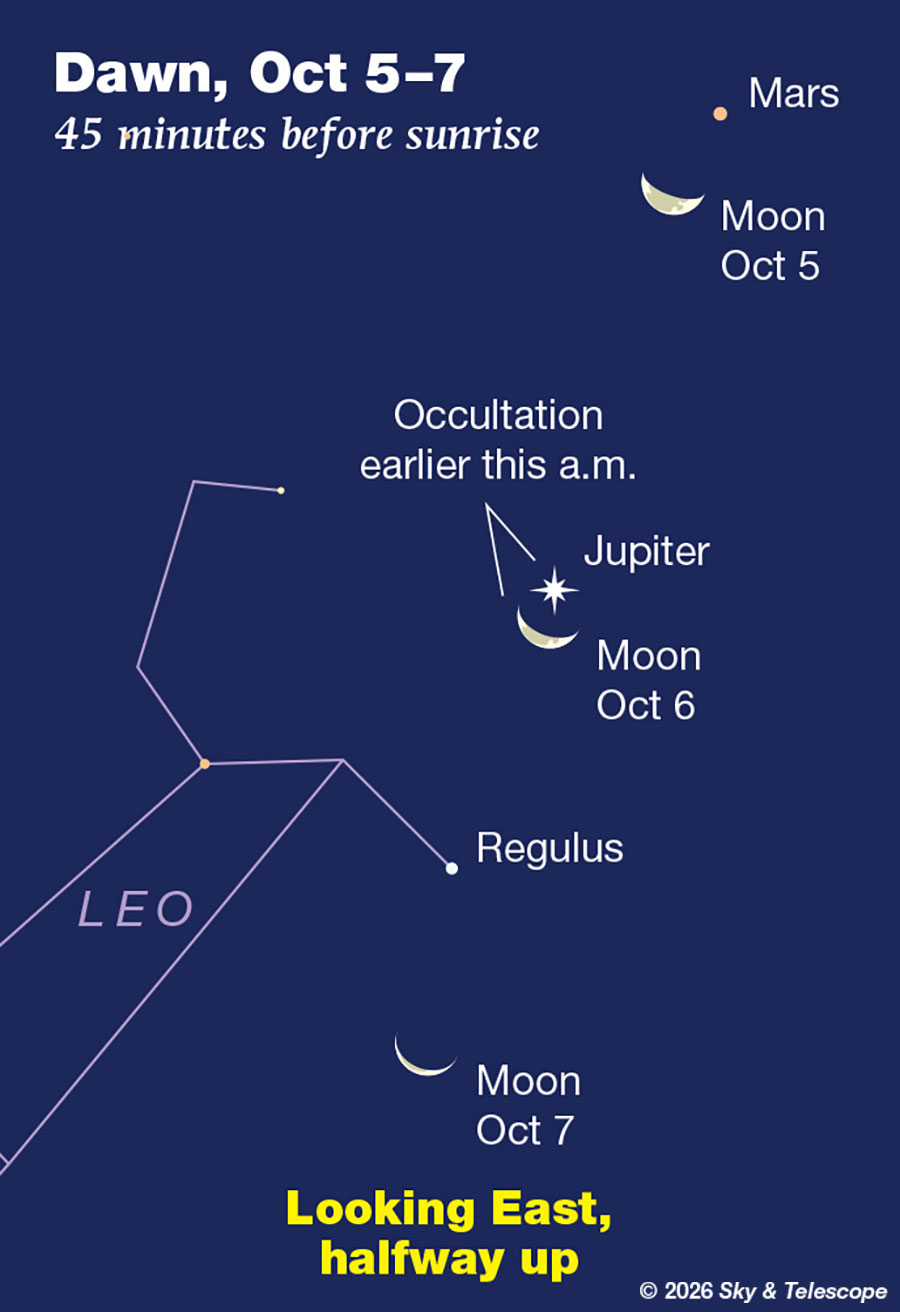
■ On the morning of Wednesday the 7th, the thinning Moon shines under Regulus and Jupiter before and during dawn, as shown below.
WEDNESDAY, OCTOBER 7
■ This is the time of year when, once nightfall is complete, W-shaped Cassiopeia stands on end halfway up the northeastern sky — and when, off to its left in the north, the dim Little Dipper extends leftward from Polaris.
THURSDAY, OCTOBER 8
■ Cassiopeia lies astride the winter Milky Way. It thus offers lots of open star clusters for telescopes, including a few within range of binoculars depending on the quality of your sky. Three Cas clusters you can try for are NGC 457, the Owl or ET cluster that includes 5th-magnitude Phi Cassiopeiae; M103, dominated by a tiny line of three stars magnitudes 7.2, 8.2, and 7.5, 0.1° long; and fluffier NGC 663.
In 7 x 50 binoculars NGC 457 looks to me like a subtle little windblown candleflame of a glow, being blown northwestward from its base of Phi Cas and its 7th-mag binocular companion.
The visibility of these subtle little cluster-glows will depend, of course, on your light pollution, your instrument, and your ability to brace the binoculars still against something. When looking high up, try lying on the ground with some heavy object placed conveniently next to your head for bracing the binoculars against.
And you must know exactly where to look. The view of Cassiopeia here shows the clusters' precise locations amid the Cassiopeia W and its star fields.
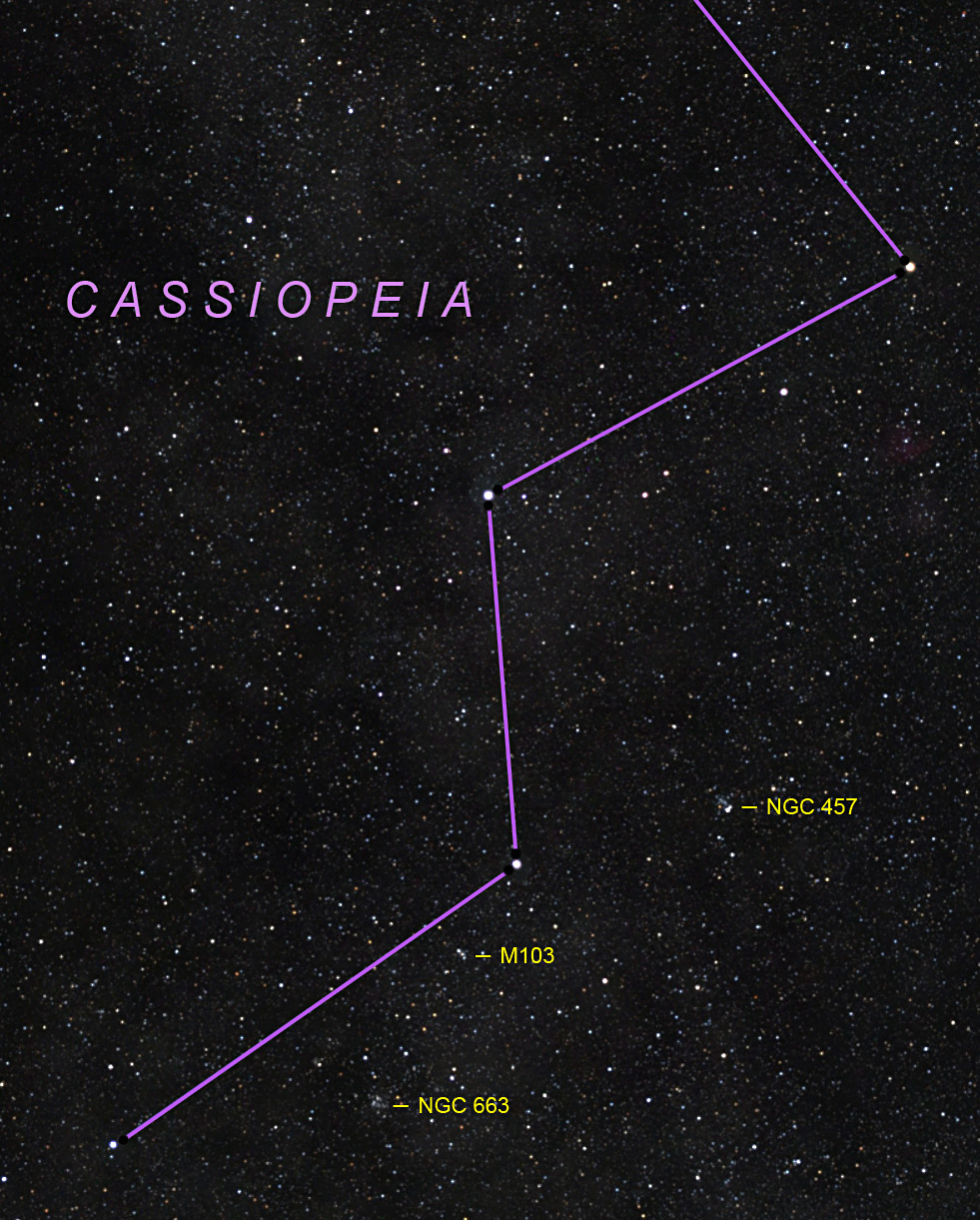
Stars by Starry Night Pro 8.
FRIDAY, OCTOBER 9
■ Soon after dark, you'll find zero-magnitude Arcturus low in the west-northwest at the same height as zero-magnitude Capella in the northeast. When this happens, turn to the south-southeast, and there will be 1st-magnitude Fomalhaut at about the same height too — exactly so if you're at latitude 43° north (Boston, Buffalo, Milwaukee, Boise, Eugene). Seen from south of that latitude Fomalhaut will appear higher; from north of there it will be lower.
SATURDAY, OCTOBER 10
■ The Great Square of Pegasus balances on its corner high in the east through much of the evening. Extending away from the Great Square's left corner is the main line of Andromeda, three 2nd-magnitude stars about as bright as those of the Square and spaced similarly far apart. (The three include the Square's corner itself.) This whole giant dipper-shaped pattern was named the Andromegasus Dipper by the late Sky & Telescope columnist George Lovi — joining the Big and Little Dippers, the Milk Dipper of Sagittarius (nowadays usually subsumed into the Teapot), and the tiny dipper pattern of the Pleiades.
Extend the Andromeda line farther left to Alpha Persei, and Andromegasus gains a longer handle to more resemble a giant Little Dipper.
SUNDAY, OCTOBER 11
■ As October proceeds, Deneb slowly replaces Vega as the zenith star of early evening (for skywatchers at mid-northern latitudes).
Accordingly, Capricornus has replaced Sagittarius as the zodiacal constellation having its best display in the south.
■ New Moon (exact at 11:50 a.m. EDT).
This Week's Planet Roundup
Mercury (magnitude –0.1) is buried deep in the sunset.
Venus (magnitude –4.6) is buried even deeper in the sunset, on its way to solar conjunction on October 23rd.
Mars (magnitude +1.1, in Cancer) rises in the east-northeast around 1 a.m. daylight-saving time, below Castor and Pollux. By the beginning of dawn you'll find Mars glowing high in the east with Castor and Pollux still above it, Procyon farther to its right, and brilliant Jupiter even farther below it.
Mars is currently the near-twin of Pollux for both brightness and color. Castor is white and somewhat fainter at magnitude +1.6 (that's the combined brightness of its two telescopic components, which are currently 5.8 arcseconds apart).
In a telescope Mars is still just a tiny, fuzzy blob 6 arcseconds wide.
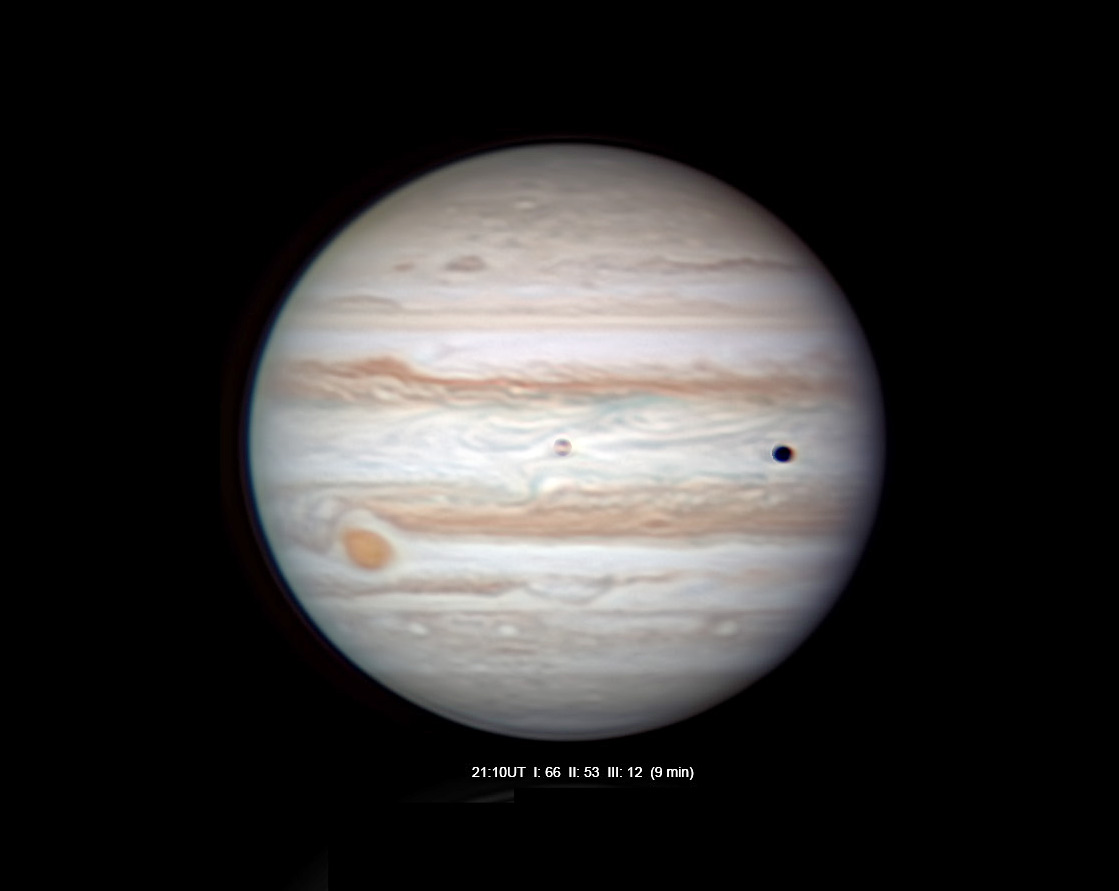
Jupiter (magnitude –1.9, at the Cancer-Leo border) rises in the east-northeast around 2 or 3 a.m. about a fist and a half below Mars. Once it's well up it shines steadily in the east as the brightest point in the sky, until becoming lost in the growing dawn. In a telescope it's still only 34 arcseconds wide.
Mars is slowly closing in on Jupiter from above. They'll pass each other at conjunction, 1.2° apart, on the morning of November 16th.
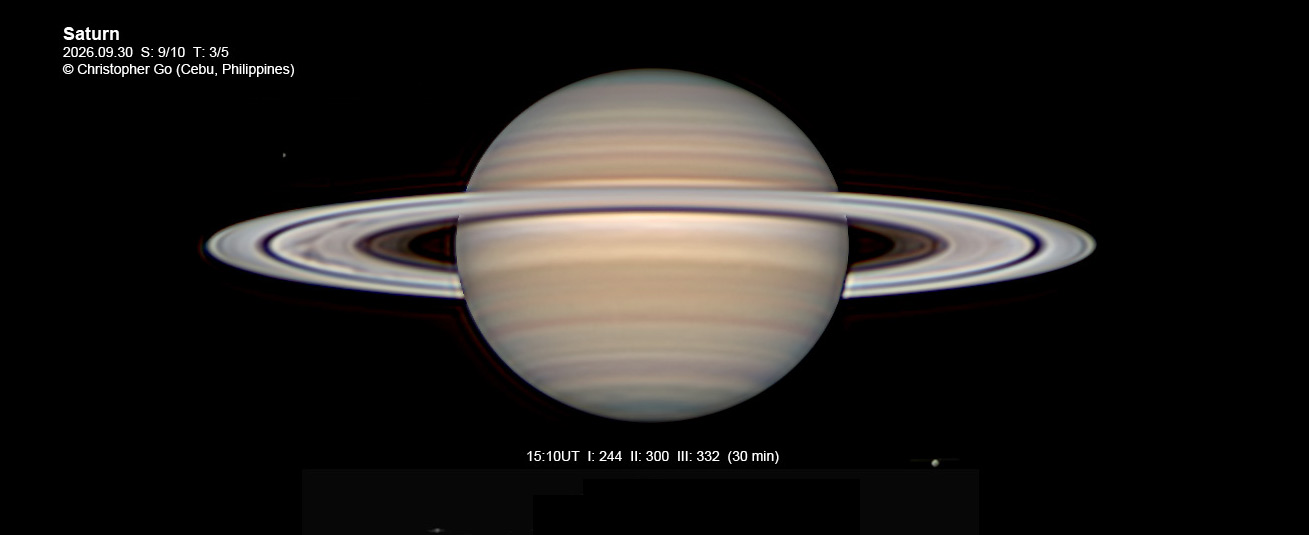
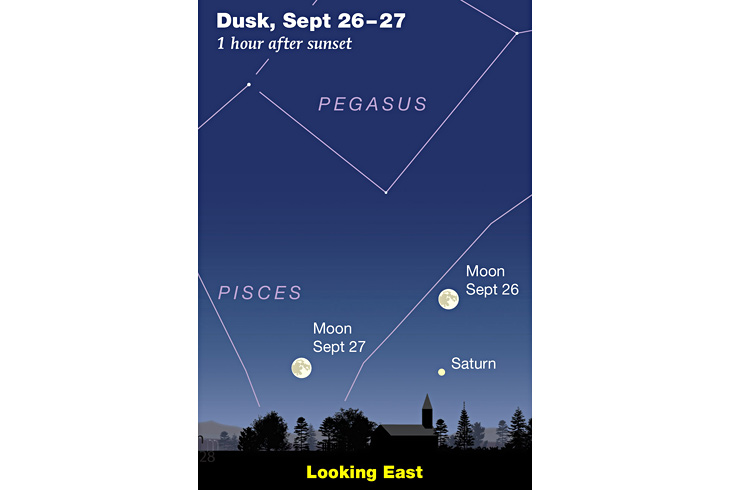
Saturn (magnitude +0.3, at the Pisces-Cetus border) is at opposition on the night of October 3-4 (for the Americas). It rises at sunset and by nightfall it's the brightest point low in the east (about a fist and a half below the dimmer Great Square of Pegasus). Saturn climbs higher through the evening. It's best placed for steady telescopic views high toward the south from late evening through early morning. It transits around 1 a.m. daylight saving time.
For several days around opposition, notice that Saturn's rings have brightened a bit compared to its globe! What you're seeing the Seeliger effect, caused by the solid ring particles backscattering sunlight to us when the illuminating Sun is directly behind us. The dusty surfaces of the Moon, Mars, and asteroids do something similar, but Saturn's clouds do not.
And Saturn's ring spokes continue to come and go, at least in large telescopes photograpically in excellent seeing.
Uranus (magnitude 5.6, in Taurus) remains halfway between the Pleiades and Aldebaran, well up in the east by late evening.
Neptune (magnitude 7.8, in Pisces) lurks even farther out in the solar system, 10° west of Saturn. It's just past its own opposition. You'll need detailed finder charts to tell Uranus and Neptune from the stars of similar brightnesses in their area.
All descriptions that relate to your horizon — including the words up, down, right, and left — are written for the world's mid-northern latitudes. Descriptions and graphics that also depend on longitude (mainly Moon positions) are for North America. Eastern Daylight Time (EDT) is Universal Time minus 4 hours. UT is also known as UTC, GMT, or Z time.
Want to become a better astronomer? Learn your way around the constellations. They're the key to locating everything fainter and deeper to hunt with binoculars or a telescope.
This is an outdoor nature hobby. For a more detailed constellation guide covering the whole evening sky, use the big monthly map in the center of each issue of Sky & Telescope, the essential magazine of astronomy.
For the attitude every amateur astronomer needs, read Jennifer Willis's Modest Expectations Give Rise to Delight.
Once you get a telescope, to put it to good use you'll want a much more detailed, large-scale sky atlas (set of charts). The basic standard is the Pocket Sky Atlas, in either the original or Jumbo Edition. Both show all 30,000 stars to magnitude 7.6, and 1,500 deep-sky targets — star clusters, nebulae, and galaxies — to search out among them.
Next up is the larger and deeper Sky Atlas 2000.0, plotting stars to magnitude 8.5; nearly three times as many, as well as many more deep-sky objects. It's currently out of print, but maybe you can find one used.
The next up, once you know your way around well, are the even larger Interstellarum Deep-Sky Atlas (with 201,000+ stars to magnitude 9.5 and 14,000 deep-sky objects selected to be detectable by eye in very large amateur telescopes), and Uranometria 2000.0 (332,000 stars to mag 9.75, and 10,300 deep-sky objects).
For the necessary tricks, read How to Use a Star Chart with a Telescope. It applies just as much to electronic charts on your phone or tablet — which many observers find handier and more versatile, if sometimes less well designed and contextualized.
You'll also want a good deep-sky guidebook. A beloved old classic is the three-volume Burnham's Celestial Handbook. It was my bedside reading for years. An impressive more modern one is the big Night Sky Observer's Guide set (2+ volumes) by Kepple and Sanner. The pinnacle for total astro-geeks is the new Annals of the Deep Sky series, currently at 12 volumes as it works its way forward through the constellations alphabetically. So far it's up to L.
Can computerized telescopes replace charts? Well, I used to say this:
"Not for beginners, I don't think, unless you prefer spending your time getting finicky technology to work rather than learning how to explore through the sky yourself. As Terence Dickinson and Alan Dyer say in their Backyard Astronomer's Guide, 'A full appreciation of the universe cannot come without developing the skills to find things in the sky and understanding how the sky works. This knowledge comes only by spending time under the stars with star maps in hand and a curious mind.' Without these, 'the sky never becomes a friendly place.' "
Well, things change. The technology has continued to improve and become more user-friendly — particularly with "plate solving" software that can now recognize any star field to determine exactly where the telescope is pointed — finally bypassing all aiming imperfections in the mount, tripod, gears, bearings and other mechanics, or in the user's skill in setting up.
The latest revolution is the rise of small, photography-only "smartscopes." These take advantage of not only today's pointing technology, but also the vastly better capabilities of imaging chips and image processing compared to the human retina and human visual cortex. The most sophisticated image stacking and processing can come built right in. The result is decent deep-sky imaging from shockingly small units, relatively low priced. The image may be viewable on your phone or computer as it builds up in real time. Some can directly enable contributions to citizen-science projects.
Smartscopes are changing the hobby at the entry level. For more on this see Richard Wright's "The Rise of the Smart Telescopes" in the November 2025 Sky & Telescope. Read the magazine's review of this especially small one.
If you get a larger, more conventional computerized scope that you can look through, make sure that its drives can be disengaged so you can swing it around and point it readily by hand when you want to, rather than only slowly by the electric motors (which eat batteries).

Sky Tour Podcast. Out under the evening sky, listen to Kelly Beatty's monthly
podcast tour of the naked-eye heavens above. It's free.
"The dangers of not thinking clearly are much greater now than ever before. It's not that there's something new in our way of thinking, it's that credulous and confused thinking can be much more lethal in ways it was never before."
—Carl Sagan, 1996, The Demon-Haunted World: Science as a Candle in the Dark
"Facts are stubborn things; and whatever may be our wishes, our inclinations, or the dictates of our passion, they cannot alter the state of facts and evidence."
— John Adams, 1770, in the summation of his unpopular, but successful, defense of British soldiers in the Boston Massacre trial
"Truly, whoever can make you believe absurdities can make you commit atrocities."
— Voltaire, 1765, Questions sur les miracles


Comments
You must be logged in to post a comment.