SUNSET:


This Week's Sky at a Glance, April 26 – May 5
All the planets now huddle around our line of sight toward the Sun. However, these moonless evenings present us the Spring Triangle, the Great Diamond with a sugar sprinkle on its edge, and the Pointers aligned vertically.
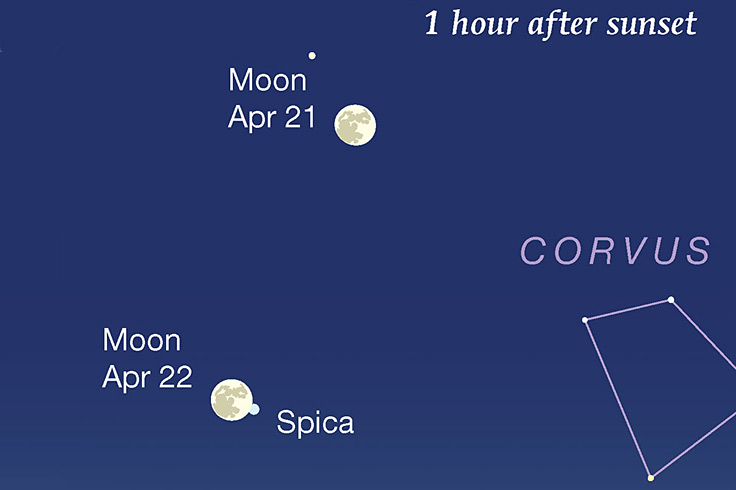
This Week's Sky at a Glance, April 19 – 28
Springtime Leo walks high in the south, springtime Hydra snakes a quarter of the way around the celestial sphere, and the bright Moon aligns with Spica.

This Week's Sky at a Glance, April 12 – 21
Jupiter is easy to spot, shining low in the west at nightfall. Near it are Uranus and Comet Pons-Brooks, tougher catches that require binoculars or a wide-field telescope — and some finding skills.

This Week's Sky at a Glance, April 5 – 14
Venus and Jupiter may shine through the blue sky during the April 8th solar eclipse even if the eclipse for you is only deep partial. After dark, Orion walks down in the southwest.

This Week's Sky at a Glance, March 29 – April 7
What? You say you're bored? The evening sky is moonless, the two Dog Stars align vertically, the Big Dipper dumps into the Little Dipper, and the Springs of the Gazelle cross the zenith.

This Week's Sky at a Glance, March 22 – 31
The full Moon will go through a penumbral eclipse. Comet Pons-Brooks nears its best showing in early evening. And as Mercury fades in the sunset, Jupiter becomes the only easy planet in the entire sky.

This Week's Sky at a Glance, March 15 – 24
Mercury emerges in the sunset, far lower right of brighter Jupiter. And don't just arc to Arcturus and speed to Spica — continue the curve to Corvus, cruise to Capella, and more.
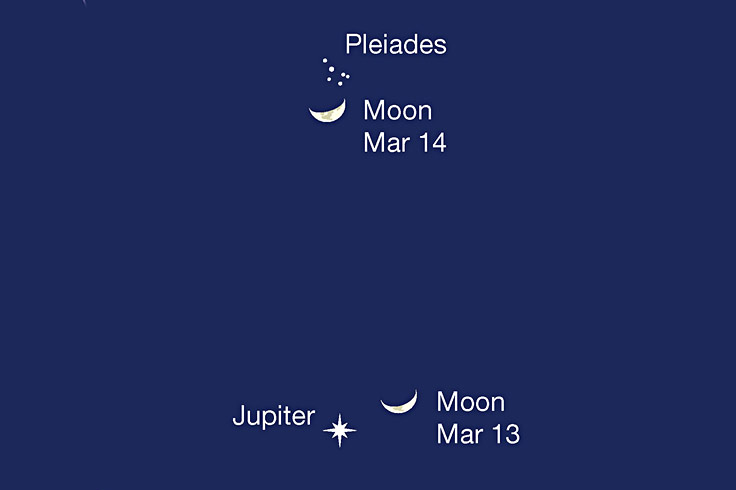
This Week's Sky at a Glance, March 8 – 17
The Moon sidles up to bold Jupiter, then the delicate Pleiades, then the Castor and Pollux twins. Arcturus, ascending in the east, is probably the third-brightest star you've ever seen and that's including the Sun.

This Week's Sky at a Glance, March 1 – 9
It's early March, so the Winter Triangle balances on Sirius after dark. The Gemini twins float high across the meridian. Leo jumps the gun on spring.

This Week's Sky at a Glance, February 23 – March 3
The full Moon splits the Sickle, the dawn Moon occults Antares, carnivore constellations stand up in the east, and the zodiacal light is at its evening best.

This Week's Sky at a Glance, February 16 – 25
The Moon waxes from first quarter to full this week, traveling from the Pleiades past the not-quite-twin heads of Gemini to the Sickle of Leo. The Big Dipper and Cassiopeia stand in balance. Venus meets Mars low in the dawn.
This Week's Sky at a Glance, February 9 – 17
The first-quarter Moon passes the Pleiades, then Aldebaran. Cassiopeia stands on end. For the southern U.S., Canopus culminates far under Sirius.

This Week's Sky at a Glance, February 2 – 11
Under Orion is the Hare, which you may know, and under the Hare is the Dove, which you may not. February the best month for both.

This Week's Sky at a Glance, January 26 – February 4
Orion anchors both the Winter Triangle and the Winter Hexagon. So does the Meat Cleaver in Canis Major. Jupiter regards them from high to their right.

This Week's Sky at a Glance, January 19 – 28
Jupiter shines high, bright, and obvious after dusk. Mercury and Mars glimmer low, dim, and elusive for their close conjunction in the dawn.

This Week's Sky at a Glance, January 12 – 21
The evening Moon passes Saturn, then Jupiter. Venus and Mercury march in lockstep in the eastern dawn. Capella, as always, paces Orion's bright foot. And who's winning the Sirius-Betelgeuse race?

This Week's Sky at a Glance, January 5 – 14
How does the Sirius-Procyon balance, newly risen, tilt for you? Depends on your latitude! Meanwhile, Triangulum and Aries teeter in balance on Jupiter.

This Week's Sky at a Glance, December 29 – January 5
Scintillating Sirius rises ever earlier to scintillate in colors. The Quadrantid meteors in the Thursday-morning dark are well timed for Eastern North America. Two triangle constellations stack over Jupiter.

This Week's Sky at a Glance, December 22 – 31
Christmas week this year puts the late-night Moon at the highest overhead you'll ever see it. High Jupiter lights the evening. Venus is the bright "star" lower in the east at dawn.

This Week's Sky at a Glance, December 15 – 24
The waxing Moon passes Saturn, jumps over Jupiter, then jumps the Pleiades. Sirius and Procyon rise earlier, but the Summer Triangle still hangs on.