Top 5 Most Recent Articles
Top 5 Most Popular Articles
OBSERVING BLOG by Kelly Beatty
Biggish Asteroid 1998 QE2 Pays Earth a Visit
The object known as 1998 QE2 is one of the largest near-Earth asteroids known. On May 31st it passes by at a distance of 3.6 million miles (5.8 million km), close enough to be studied by radar astronomers.
Usually, when a small asteroid comes close to Earth, it's here and gone in a matter of hours. But that's not the case with 1998 QE2, which is making a courtesy call this week. It appears brighter than 12th magnitude from now through to June 7th, peaking at 10.7 on the nights of June 1st and 2nd.
Discovered by the LINEAR robotic telescope nearly 15 years ago, 1998 QE2 was soon identified in enough images to nail down its orbit and earn it the minor-planet number 285263, though it has yet to be named. But it was swept up a decade later in a survey of near-Earth objects by the Spitzer Space Telescope. That infrared signature, together with visual observations, led David Trilling (Northern Arizona University) and others to conclude that this asteroid has a diameter of 1.7 miles (2.7 km), meaning that it ranks as one of the largest near-Earth asteroids (NEAs) known.
Based on a 3.77-year orbit that brings it as close as 1.049 astronomical units to the Sun, 1998 QE2 is classified as an Amor asteroid. It's also been tagged as a potentially hazardous object by the IAU's Minor Planet Center, but there's nothing to fear from this giant space rock in the near future.
Instead, this week it will glide slowly past us, coming no closer than 3.6 million miles (5.8 million km) at 4:59 p.m. EDT (20:59 Universal Time) on May 31st. That's about 15 times farther than the Moon. Yet, according to a NASA press release, this is its closest approach to Earth for at least the next two centuries. Here's a simulation, from the asteroid's perspective, of its flyby past the Earth-Moon system.
Astronomers are already pinging radar bursts off the visitor to learn more about it — and they've already gotten a big surprise: it's got a satellite! In a series of observations on May 29th with the space agency's big 230-foot (70-m) antenna at Goldstone, California, Marina Brozović (Jet Propulsion Laboratory) led a team that made the discovery.
As seen at right, the radar-bright companion appears to be moving independently of its parent body. According to NASA's announcement earlier today, the satellite's apparently small radar reflection is deceiving: it's actually close to 2,000 feet (600 m) wide. Note the dark mottling seen on 1998 QE2 as it rotates (in about 4 hours, based on these frames). These are likely concavities in its surface.
Binary asteroids are not rare among NEAs. Statistically, they account for about a sixth of those objects that are at least 650 feet (200 m) in diameter.
According to Lance Benner (Jet Propulsion Laboratory), the big Goldstone antenna will continue making its radar observations through June 9th. The even larger dish at Arecibo, Puerto Rico, is planning to track the interloper from June 6th to 12th. If these observations go smoothly, the resulting radar maps could resolve details on the asteroid's surface as small as 12½ feet (3¾ m) — a 20-fold improvement over the first looks seen here.
It might be big and slow-moving, but spotting 1998 QE2 telescopically will be a challenge. Until now it's been positioned moderately deep in the southern sky, moving slowly northward through Centaurus and Hydra. This coming week it glides a bit east of Zubenelgenubi and Zubeneschamali, the anchor stars in Libra.
Your best bet is to utilize the "Horizons" system at NASA's Jet Propulsion Laboratory to generate a custom ephemeris for your location. To do this, go to the ephemeris page for this object, enter your location and the time span desired, and click on the "Generate Ephemeris" button. This will provide coordinates that you can then plot on a star chart that, preferably, includes stars to 12th magnitude. Alternately, you can input the orbital elements for 1998 QE2, provided by either Horizons, the Minor Planet Center, or the European Space Agency's NEODys-2, into a star-charting program.
If you'd rather just watch from afar, there are opportunities for that too. NASA is planning three social-media events. Today at 1:30 p.m. EDT (17:30 UT), live images of the asteroid are being shown on NASA Television and on the space agency's Ustream channel, along with commentary by NASA administrator Charles Bolden and asteroid specialists from JPL. A two-hour online chat with William Cooke (NASA-Marshall Space Flight Center) begins later today at 5 p.m. EDT (21:00 UT). And on May 31st at 11 a.m. EDT (15:00 UT), NASA deputy administrator Lori Garver will participate in a White House "We the Geeks" Google+ Hangout.
Elsewhere on May 31st, you can watch the robotic Slooh Space Camera tracking the asteroid beginning at 1:30 p.m. (20:30 UT). Italian astronomer Gianluca Masi is hosting host a live, online session with Bellatrix Observatory's Virtual Telescope beginning at 20:30 UT (2:30 p.m. EDT).
Usually, when a small asteroid comes close to Earth, it's here and gone in a matter of hours. But that's not the case with 1998 QE2, which is making a courtesy call this week. It appears brighter than 12th magnitude from now through to June 7th, peaking at 10.7 on the nights of June 1st and 2nd.
Discovered by the LINEAR robotic telescope nearly 15 years ago, 1998 QE2 was soon identified in enough images to nail down its orbit and earn it the minor-planet number 285263, though it has yet to be named. But it was swept up a decade later in a survey of near-Earth objects by the Spitzer Space Telescope. That infrared signature, together with visual observations, led David Trilling (Northern Arizona University) and others to conclude that this asteroid has a diameter of 1.7 miles (2.7 km), meaning that it ranks as one of the largest near-Earth asteroids (NEAs) known.
The elongated orbit of asteroid 1998 QE2 averages 2.42 astronomical units from the Sun but comes quite close to Earth. Click here for a larger version.
NASA / JPL
Instead, this week it will glide slowly past us, coming no closer than 3.6 million miles (5.8 million km) at 4:59 p.m. EDT (20:59 Universal Time) on May 31st. That's about 15 times farther than the Moon. Yet, according to a NASA press release, this is its closest approach to Earth for at least the next two centuries. Here's a simulation, from the asteroid's perspective, of its flyby past the Earth-Moon system.
Astronomers are already pinging radar bursts off the visitor to learn more about it — and they've already gotten a big surprise: it's got a satellite! In a series of observations on May 29th with the space agency's big 230-foot (70-m) antenna at Goldstone, California, Marina Brozović (Jet Propulsion Laboratory) led a team that made the discovery.
The first radar images of asteroid 1998 QE2, acquired on May 29, 2013, revealed that the asteroid has a companion (whitish spot). Radar illumination is from the top, and the resolution is about 250 feet (75 m).
NASA / JPL / GSSR
Binary asteroids are not rare among NEAs. Statistically, they account for about a sixth of those objects that are at least 650 feet (200 m) in diameter.
According to Lance Benner (Jet Propulsion Laboratory), the big Goldstone antenna will continue making its radar observations through June 9th. The even larger dish at Arecibo, Puerto Rico, is planning to track the interloper from June 6th to 12th. If these observations go smoothly, the resulting radar maps could resolve details on the asteroid's surface as small as 12½ feet (3¾ m) — a 20-fold improvement over the first looks seen here.
It might be big and slow-moving, but spotting 1998 QE2 telescopically will be a challenge. Until now it's been positioned moderately deep in the southern sky, moving slowly northward through Centaurus and Hydra. This coming week it glides a bit east of Zubenelgenubi and Zubeneschamali, the anchor stars in Libra.
Your best bet is to utilize the "Horizons" system at NASA's Jet Propulsion Laboratory to generate a custom ephemeris for your location. To do this, go to the ephemeris page for this object, enter your location and the time span desired, and click on the "Generate Ephemeris" button. This will provide coordinates that you can then plot on a star chart that, preferably, includes stars to 12th magnitude. Alternately, you can input the orbital elements for 1998 QE2, provided by either Horizons, the Minor Planet Center, or the European Space Agency's NEODys-2, into a star-charting program.
A 11-image sequence taken on May 31, 2013, shows asteroid 1998 QE2 moving among faint stars near Libra's intersection with Virgo and Hydra. Gavin Khoo recorded this series of 10-second-long exposures, one per minute, using an 8-inch telescope and Canon EOS 60D camera.
Gavin Khoo
Elsewhere on May 31st, you can watch the robotic Slooh Space Camera tracking the asteroid beginning at 1:30 p.m. (20:30 UT). Italian astronomer Gianluca Masi is hosting host a live, online session with Bellatrix Observatory's Virtual Telescope beginning at 20:30 UT (2:30 p.m. EDT).
Posted by Kelly Beatty, May 30, 2013
|
|
|
||
|
|
Date:
|

OBSERVING BLOG by Tony Flanders
The May-June 2013 Planet Dance
A remarkable series of events takes place low in the west-northwest shortly after sunset from late May to late June. It features the tightest three-planet grouping visible without binoculars until 2026 and an excellent apparition of Mercury.
Venus and Jupiter, the two brightest planets, have been approaching each other all month. Mercury, currently the third-brightest planet, becomes visible to Venus's lower right around May 19th. It appears closer to Venus each evening until May 24th, when it's just 1⅓° upper right of Venus.
From May 24th to 29th, Venus, Jupiter, and Mercury all fit within a 5° circle. That means that you can view all three at the same time with most hand-held binoculars.
The grouping is tightest on May 26th, when all three planets fit in a 2½° circle. Jupiter appears right next to Venus on the 27th, and after that it slowly pulls down and right of Venus, disappearing from view in early June.
But Mercury is only now entering the prime evenings of this apparition, soaring ever higher above Venus until June 7th, when it slowly begins to sink back toward Venus. But as always during an evening apparition, Mercury is beginning to fade — slowly at first but increasingly rapidly after mid-June.
Mercury was nearly as bright as Jupiter at the beginning of this apparition, but it has faded tenfold by June 20th, appearing no brighter than the stars Castor and Pollux above it.
Watch an animation of the entire amazing three-planet conjunction:
Gavin Khoo
From May 24th to 29th, Venus, Jupiter, and Mercury all fit within a 5° circle. That means that you can view all three at the same time with most hand-held binoculars.
The grouping is tightest on May 26th, when all three planets fit in a 2½° circle. Jupiter appears right next to Venus on the 27th, and after that it slowly pulls down and right of Venus, disappearing from view in early June.
But Mercury is only now entering the prime evenings of this apparition, soaring ever higher above Venus until June 7th, when it slowly begins to sink back toward Venus. But as always during an evening apparition, Mercury is beginning to fade — slowly at first but increasingly rapidly after mid-June.
Mercury was nearly as bright as Jupiter at the beginning of this apparition, but it has faded tenfold by June 20th, appearing no brighter than the stars Castor and Pollux above it.
Watch an animation of the entire amazing three-planet conjunction:
Posted by Tony Flanders, February 21, 2013

OBSERVING BLOG by Babak Tafreshi
TWAN's Earth & Sky Contest Winners
From the city lights nestled between Alpine peaks to a single image that captures stars, an aurora, and a meteor, The World At Night's 2013 astrophoto contest is full of startling vistas.
In many ways exploring the night sky is like an adventure trip to an unseen cave or savoring a mountaintop vista that few others have witnessed. But there's greater enjoyment when you share the experience with others. That's the essence of The World at Night (TWAN) program and its Earth & Sky Photo Contest on Dark Skies Importance.
Unfortunately, with two-thirds of the world's population living in light-polluted areas, the night sky might become a forgotten part of urban life. So TWAN's annual contest, now in its fourth year, strives to make an impact on public awareness of beauty of night sky as part of our nature and importance of preserving dark skies from increasing light pollution in our often libertine modernity.
Contestants from 45 countries submitted a remarkable 700 images, all taken since the beginning of 2012. This is double the count from last year — yet another sign that public interest in the night sky and the hobby of astrophotography is growing. As noted by one of our distinguished adjudicators, David Malin, "The entries represent some of the best TWAN-style photographs ever gathered together in one place. Judging them was a significant challenge because the standard was very high."
"The Envelope, Please"
Submitted photos were judged in two categories: Beauty of the Night Sky and Against the Lights. Each category had five winners, and 50 other notable photos are featured in our contest video. All images were created with a landscape style that combines elements of the night sky with a notable location or landmark. The images were submitted during the just-ended Global Astronomy Month.
A strong example of how natural beauty of night sky can affect people is the winner image "Crossed Destinies" by Luc Perrot from the French island Réunion (near Madagascar). The outstanding Milky Way above Indian Ocean has no hint of our modern world, either in the sky or on the land.
Another winner is a lucky and well done photo by Shannon Bileski of Winnipeg, Canada, in which the starry sky, an aurora storm, and a streaking fireball are captured in one frame. What else do you need in a stargazing night?!
We were pleased to see Shannon among our winners. At my workshops around the world, I meet many dedicated and advanced TWAN-style photographers — but few of them are female, even though women are quite active in other fields of photography. My colleague Mike Simmons, founder of Astronomers Without Borders, comments, "TWAN-style photography is meant to be accessible to everyone on Earth, and the all-male nature of the field to date is contrary to that ideal."
In the Against the Lights category, first-place winner "Under the Hood" is all beauty at first glance. But then you realize that photographer Andreas Max Böckle has moved to the mountaintops outside the city of Salzburg to separate himself from light pollution. Trapped beneath the yellow light cast, Salzburg's residents are no longer able to see this celestial beauty. (The International Dark Sky Association offers much more information about fighting light pollution.)
This year an Austrian also won the Summer Solstice Festival photo contest, as was the case in both 2011 and 2012. It's partly because alpine vistas offer some of the last remaining natural starry skies in the western Europe, and partly because city lights nestled in mountain valleys make an eye-catching contrast to the sky above. But Austrian amateur astronomers have been very active in all kinds of advanced astrophotography in recent years. They organize the Central European Deep Sky Imaging Conference every other year in Linz, Austria, which brings together astrophotographers from around the globe.
TWAN organized the Earth & Sky Photo Contest in collaboration with education/outreach specialists at the National Optical Astronomy Observatory. While most of the judges are TWAN members, we also invited astroimaging experts. Among them this year was Jerry Bonnel, a scientist at NASA's Goddard Space Flight Center and co-editor of Astronomy Picture of the Day (APOD).
For those who want to participate in our 2014 contest, I recommend that you start now! The entries will be images made between January 2013 and April 2014. Good luck, and clear skies!
Babak A. Tafreshi is a freelance photographer, science journalist, and astronomy communicator. He is founder and director of The World at Night (TWAN) program, a board member of Astronomers Without Borders, and a contributing photographer for Sky & Telescope.
In many ways exploring the night sky is like an adventure trip to an unseen cave or savoring a mountaintop vista that few others have witnessed. But there's greater enjoyment when you share the experience with others. That's the essence of The World at Night (TWAN) program and its Earth & Sky Photo Contest on Dark Skies Importance.
The otherwolrdly feel in "Crossed Destinies" was captured over the Indian Ocean island of Réunion. Click here for a larger view.
© Luc Perrot
Contestants from 45 countries submitted a remarkable 700 images, all taken since the beginning of 2012. This is double the count from last year — yet another sign that public interest in the night sky and the hobby of astrophotography is growing. As noted by one of our distinguished adjudicators, David Malin, "The entries represent some of the best TWAN-style photographs ever gathered together in one place. Judging them was a significant challenge because the standard was very high."
"The Envelope, Please"
Submitted photos were judged in two categories: Beauty of the Night Sky and Against the Lights. Each category had five winners, and 50 other notable photos are featured in our contest video. All images were created with a landscape style that combines elements of the night sky with a notable location or landmark. The images were submitted during the just-ended Global Astronomy Month.
A strong example of how natural beauty of night sky can affect people is the winner image "Crossed Destinies" by Luc Perrot from the French island Réunion (near Madagascar). The outstanding Milky Way above Indian Ocean has no hint of our modern world, either in the sky or on the land.
In "Meteor Magic", Shannon Bileski captured stars, an aurora, and a fireball over Manitoba. Click here for a larger view.
© Shannon Bileski
We were pleased to see Shannon among our winners. At my workshops around the world, I meet many dedicated and advanced TWAN-style photographers — but few of them are female, even though women are quite active in other fields of photography. My colleague Mike Simmons, founder of Astronomers Without Borders, comments, "TWAN-style photography is meant to be accessible to everyone on Earth, and the all-male nature of the field to date is contrary to that ideal."
In the Against the Lights category, first-place winner "Under the Hood" is all beauty at first glance. But then you realize that photographer Andreas Max Böckle has moved to the mountaintops outside the city of Salzburg to separate himself from light pollution. Trapped beneath the yellow light cast, Salzburg's residents are no longer able to see this celestial beauty. (The International Dark Sky Association offers much more information about fighting light pollution.)
Thin clouds add drama to the stars above and the blanket of city lights below in Salzburg, Austria. Click here for a larger view.
© Andreas Max Böckle
TWAN organized the Earth & Sky Photo Contest in collaboration with education/outreach specialists at the National Optical Astronomy Observatory. While most of the judges are TWAN members, we also invited astroimaging experts. Among them this year was Jerry Bonnel, a scientist at NASA's Goddard Space Flight Center and co-editor of Astronomy Picture of the Day (APOD).
For those who want to participate in our 2014 contest, I recommend that you start now! The entries will be images made between January 2013 and April 2014. Good luck, and clear skies!
Babak A. Tafreshi is a freelance photographer, science journalist, and astronomy communicator. He is founder and director of The World at Night (TWAN) program, a board member of Astronomers Without Borders, and a contributing photographer for Sky & Telescope.
Posted by Babak Tafreshi, May 17, 2013

OBSERVING BLOG by The Editors of Sky & Telescope
Australia's Ring of Fire Eclipse
For the second time in six months, the Sun has graced Down Under with an eclipse. Only a lucky few caught this annular eclipse, which traversed sparsely populated northern Australia.
Yesterday's annular "ring of fire" eclipse passed over only sparsley populated regions, although Australians, Hawaiians, and others caught the partial phases.
Greg Bryant, editor of the Australian edition of Sky & Telescope, reports:
"Just six months after the Moon's shadow last touched down on Australian soil (the glorious total solar eclipse in North Queensland which I attended as part of the Sky & Telescope / Insight Cruises tour), another solar eclipse graced our shores. This time, it was an annular, visible across parts of northern Australia, with the partial stage observable elsewhere throughout Australia.
I chose to observe this one from home in Sydney, enjoying the first partial solar eclipse I'd seen from my home of 11 years. It was a beautiful sky with not a cloud to be seen, and I followed the Moon as it eclipsed up to ~27% of the Sun. I had solar glasses from last year's eclipse trip with me, along with an iOptron solar 60 refractor."
"Dawn was strange," says Jörg Schoppmeyer, who watched the eclipse in northern Australia with Nicole Hollenbach and others, observing from a hill near the Great Northern Highway around 70 km south of Newman.
"The eclipse started under the horizon and the light from the more upcoming sun was compensated by Moon blocking more and more of the Sun. So the morning somehow refused to start."
See more of Schoppmeyer's photos.
Jay Pasachoff sent the following report to the Solar Eclipse Mailing List:
"We can report good success in observing 4 min 20 s of annularity at the eclipse today, about 100 km north of Tennant Creek, Northern Territory, Australia. At the side of the road there was a turnoff to a hill that carried a radio repeater, and about 100 people had gathered there in the very early morning in anticipation of the 8:05 am annularity.
There were clouds in the sky, and much of the eclipse was viewed through thin clouds, though rarely after the first few minutes was the sun obscured. The clouds thinned considerably before annularity, which was observed in a pretty clear sky. The air cooled noticeably when the Sun was almost entirely covered, and the shadows sharpened because they were being cast by a thin crescent of sun."
Observing an eclipse begets hunger for more. "We now look forward to the next total eclipse of the Sun, which will be visible from Gabon, Africa, on November 3," says Pasachoff. (S&T will be guiding a tour to Kenya to view this eclipse.) "Another annular eclipse, on April 29, 2014, will have its annularity visible only from an inaccessible ocean spot off Antarctica, but Australia will see about 60% coverage."
Bryant adds, "As the Moon shrank away from the Sun, I thought to what lies ahead for me here in Sydney." After the April 2014 eclipse, "the next partial eclipse is in 2023, though it will be less than what I saw today. That 2023 eclipse is total in Western Australia, the first of FIVE total solar eclipses that will cross Australia between 2023 and 2038!"
"One of those is the total solar eclipse in July 2028, with totality visible from my backyard. I'm looking forward to that, but it's still 15 years away. Inspired further by this morning's beautiful views, I think I might have to do some eclipse-chasing in the meantime..."
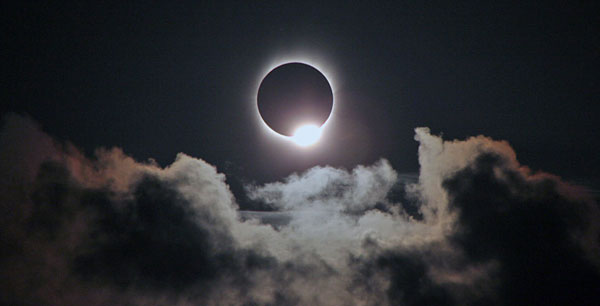
The "ring of fire" eclipse appeared above a cloud bank of faraway thunderstorms. The real eclipse is overexposed, and the double image comes from reflection within the camera's lens.
Nicole Hollenbeck
Greg Bryant, editor of the Australian edition of Sky & Telescope, reports:
"Just six months after the Moon's shadow last touched down on Australian soil (the glorious total solar eclipse in North Queensland which I attended as part of the Sky & Telescope / Insight Cruises tour), another solar eclipse graced our shores. This time, it was an annular, visible across parts of northern Australia, with the partial stage observable elsewhere throughout Australia.
I chose to observe this one from home in Sydney, enjoying the first partial solar eclipse I'd seen from my home of 11 years. It was a beautiful sky with not a cloud to be seen, and I followed the Moon as it eclipsed up to ~27% of the Sun. I had solar glasses from last year's eclipse trip with me, along with an iOptron solar 60 refractor."
"Dawn was strange," says Jörg Schoppmeyer, who watched the eclipse in northern Australia with Nicole Hollenbach and others, observing from a hill near the Great Northern Highway around 70 km south of Newman.
"The eclipse started under the horizon and the light from the more upcoming sun was compensated by Moon blocking more and more of the Sun. So the morning somehow refused to start."
See more of Schoppmeyer's photos.
Jay Pasachoff sent the following report to the Solar Eclipse Mailing List:
Jörg "Schoppy" Schoppmeyer shot this close-up on the annular eclipse.
Jörg Schoppmeyer
There were clouds in the sky, and much of the eclipse was viewed through thin clouds, though rarely after the first few minutes was the sun obscured. The clouds thinned considerably before annularity, which was observed in a pretty clear sky. The air cooled noticeably when the Sun was almost entirely covered, and the shadows sharpened because they were being cast by a thin crescent of sun."
Observing an eclipse begets hunger for more. "We now look forward to the next total eclipse of the Sun, which will be visible from Gabon, Africa, on November 3," says Pasachoff. (S&T will be guiding a tour to Kenya to view this eclipse.) "Another annular eclipse, on April 29, 2014, will have its annularity visible only from an inaccessible ocean spot off Antarctica, but Australia will see about 60% coverage."
Bryant adds, "As the Moon shrank away from the Sun, I thought to what lies ahead for me here in Sydney." After the April 2014 eclipse, "the next partial eclipse is in 2023, though it will be less than what I saw today. That 2023 eclipse is total in Western Australia, the first of FIVE total solar eclipses that will cross Australia between 2023 and 2038!"
"One of those is the total solar eclipse in July 2028, with totality visible from my backyard. I'm looking forward to that, but it's still 15 years away. Inspired further by this morning's beautiful views, I think I might have to do some eclipse-chasing in the meantime..."
Posted by The Editors of Sky & Telescope, May 10, 2013

OBSERVING BLOG by Alan MacRobert
See Saturn at Its Best for 2013
With its rings tipped nicely into wide view, right now the ringed planet is its closest to Earth — making it a visual treat in telescopes of any size.
Saturn takes over from Jupiter as the starring planet of the evening sky this spring, and right now it's closer, bigger, and brighter than at any time for the rest of the year. The ringed planet comes to opposition on the night of April 27-28, and for the next few weeks it remains essentially the same apparent size: 19″ across at the equator and 42″ across from ring-tip to ring-tip (about a Jupiter-width).
Saturn shines fairly high in the southeast by early evening, below Arcturus and Spica. If you still haven't looked at Saturn in a telescope since last year, the change will be dramatic. The rings now present themselves very invitingly, tilted a wide 17° or 18° from our line of sight, the widest they've appeared since 2006. They will continue to open (with minor seasonal fluctuations) until reaching a maximum of 27° in 2017.
The smallest astronomical telescope should reveal the rings easily and, with a little more effort, the dark Cassini Division between the A and B rings. The dusky C ring is more of a challenge to spot where it appears against the dark-sky background, but its dark shading is easier to see where it crosses Saturn's bright face just inside the B ring.
Seeing any further detail in the rings really takes magnification upwards of 200× on a high-quality 8-inch or larger scope. It also takes time and patience. Rare is the night when the atmospheric seeing is steady and sharp enough to let your scope do its best. Moreover, it takes a lot of time gazing into the eyepiece to register everything at the limit of your vision. Very subtle banding in the rings is occasionally detectable under near-perfect conditions.
For several night around this week's opposition, watch for the Seeliger effect: a noticeable brightening of the rings with respect to the globe. This is caused by the fact that the solid-ice ring particles "backscatter" sunlight back in the direction it came from more effectively than the planet's cloud tops do.
In the weeks and months after opposition, note the increasingly visible shadow of the planet's globe on the rings. It's the narrow black gap right where the rings pass behind the globe's celestial east (following) side. After opposition, we start seeing a little around the planet's eastern edge compared to the direction of the incoming sunlight.
More to See Than Just Rings
Like Jupiter, Saturn is gas planet showing us banded cloud tops. But Saturn is both smaller and farther than Jupiter, and its markings are more deeply veiled under high-altitude haze. Even so, my 6-inch scope almost always shows some banding: the bright Equatorial Zone, the slightly darker North Equatorial Belt (its southern sibling is behind the rings now), and the dusky North Polar Region. Occasional subtler banding is sometimes detectable in the mid-latitudes. During moments of steady seeing, large scopes often show tinier white spots, which are localized storms. Get other tips from our Saturn observing guide.
Of course, Saturn and its rings are surrounded by extra baubles: more moons for amateur scopes than around any other planet. Even a 60-mm scope will usually reveal appropriately named Titan, a world half again as big as our Moon. A 6-inch will show Titan's orange color: the photochemical smog that makes its thick atmosphere opaque, hiding Titan's rainclouds, rivers, and lakes of liquefied natural gas.
A 4- or 6-inch scope will also show Iapetus, Rhea, Dione, and (with a little difficulty) Tethys. An 8-inch may also get you fainter Enceladus closer in. You can identify the moons, or find exactly where to look for them, at any time and date using S&T.com's Saturn's moons observing aid (requires free site registration) — or, for handy use at your scope, get our new Saturn's moons app for your iPhone.
And of course, take every opportunity to show Saturn to other people! So many amateurs remember a first view of Saturn as the thing that opened to them the riches of astronomy.
Saturn takes over from Jupiter as the starring planet of the evening sky this spring, and right now it's closer, bigger, and brighter than at any time for the rest of the year. The ringed planet comes to opposition on the night of April 27-28, and for the next few weeks it remains essentially the same apparent size: 19″ across at the equator and 42″ across from ring-tip to ring-tip (about a Jupiter-width).
Saturn shines fairly high in the southeast by early evening, below Arcturus and Spica. If you still haven't looked at Saturn in a telescope since last year, the change will be dramatic. The rings now present themselves very invitingly, tilted a wide 17° or 18° from our line of sight, the widest they've appeared since 2006. They will continue to open (with minor seasonal fluctuations) until reaching a maximum of 27° in 2017.
Saturn's main telescopic features are labeled on this fine photograph taken by Robert English on February 7, 2012, with a 20-inch Newtonian reflector. At the time the rings were tilted 15°.
Robert English
Seeing any further detail in the rings really takes magnification upwards of 200× on a high-quality 8-inch or larger scope. It also takes time and patience. Rare is the night when the atmospheric seeing is steady and sharp enough to let your scope do its best. Moreover, it takes a lot of time gazing into the eyepiece to register everything at the limit of your vision. Very subtle banding in the rings is occasionally detectable under near-perfect conditions.
The Seeliger effect: Christopher Go took these images of Saturn on March 2nd (top) and April 24th. Notice how the rings brightened with respect to the globe. And on the 24th, Saturn was still three days from opposition.
In the weeks and months after opposition, note the increasingly visible shadow of the planet's globe on the rings. It's the narrow black gap right where the rings pass behind the globe's celestial east (following) side. After opposition, we start seeing a little around the planet's eastern edge compared to the direction of the incoming sunlight.
More to See Than Just Rings
Like Jupiter, Saturn is gas planet showing us banded cloud tops. But Saturn is both smaller and farther than Jupiter, and its markings are more deeply veiled under high-altitude haze. Even so, my 6-inch scope almost always shows some banding: the bright Equatorial Zone, the slightly darker North Equatorial Belt (its southern sibling is behind the rings now), and the dusky North Polar Region. Occasional subtler banding is sometimes detectable in the mid-latitudes. During moments of steady seeing, large scopes often show tinier white spots, which are localized storms. Get other tips from our Saturn observing guide.
Of course, Saturn and its rings are surrounded by extra baubles: more moons for amateur scopes than around any other planet. Even a 60-mm scope will usually reveal appropriately named Titan, a world half again as big as our Moon. A 6-inch will show Titan's orange color: the photochemical smog that makes its thick atmosphere opaque, hiding Titan's rainclouds, rivers, and lakes of liquefied natural gas.
A 4- or 6-inch scope will also show Iapetus, Rhea, Dione, and (with a little difficulty) Tethys. An 8-inch may also get you fainter Enceladus closer in. You can identify the moons, or find exactly where to look for them, at any time and date using S&T.com's Saturn's moons observing aid (requires free site registration) — or, for handy use at your scope, get our new Saturn's moons app for your iPhone.
And of course, take every opportunity to show Saturn to other people! So many amateurs remember a first view of Saturn as the thing that opened to them the riches of astronomy.
Posted by Alan MacRobert, April 26, 2013
OBSERVING BLOG by Kelly Beatty
April 25th's Partial Lunar Eclipse
Truly dedicated eclipse-watchers — who live in the Eastern Hemisphere — have a chance to watch the Moon barely graze Earth's umbra during the first eclipse of 2013.
A lunar eclipse will take place on April 25th, but it'll go unnoticed unless you're paying close attention to the full Moon's appearance that night. And to see it at all you'll need to be Europe, Asia, Africa, or Australia — this event is not visible from North America.
It's almost deceptive to call this first cover-up of 2013 a partial eclipse. Only about 1% of the Moon's disk (a tiny bite only 0.5 arcminute deep) manages to slip into Earth's umbral shadow, as the graphic here shows. That umbral passage lasts for just 27 minutes centered on 20:08 Universal Time. Eclipse guru Fred Espenak provides more specifics at NASA's eclipse website.
Still, careful observers might notice some dusky penumbral shading along the Moon's northern limb beginning about 19:00 UT and ending near 21:00 UT. And Saturn, perched a few degrees to the Moon's northeast, will add some variety to the scene. Wide-field photographs made with medium telephoto lenses might turn out interesting.
Lunar and solar eclipses often come in pairs, and sure enough April's event will be followed two weeks later (at new Moon) by an annular solar eclipse that's observable in Australia and across the South Pacific. More details are found on S&T.com's Eclipses in 2013 page.
A lunar eclipse will take place on April 25th, but it'll go unnoticed unless you're paying close attention to the full Moon's appearance that night. And to see it at all you'll need to be Europe, Asia, Africa, or Australia — this event is not visible from North America.
It's almost deceptive to call this first cover-up of 2013 a partial eclipse. Only about 1% of the Moon's disk (a tiny bite only 0.5 arcminute deep) manages to slip into Earth's umbral shadow, as the graphic here shows. That umbral passage lasts for just 27 minutes centered on 20:08 Universal Time. Eclipse guru Fred Espenak provides more specifics at NASA's eclipse website.
Still, careful observers might notice some dusky penumbral shading along the Moon's northern limb beginning about 19:00 UT and ending near 21:00 UT. And Saturn, perched a few degrees to the Moon's northeast, will add some variety to the scene. Wide-field photographs made with medium telephoto lenses might turn out interesting.
Lunar and solar eclipses often come in pairs, and sure enough April's event will be followed two weeks later (at new Moon) by an annular solar eclipse that's observable in Australia and across the South Pacific. More details are found on S&T.com's Eclipses in 2013 page.
Posted by Kelly Beatty, April 19, 2013

OBSERVING BLOG by Alan MacRobert
Lyrid Meteor Shower in 2013
The annual Lyrid meter shower is not typically dramatic, and this year strong moonlight will interfere. But skywatchers should be alert for a possible outburst on the night of April 2122.
Late nights and mornings around April 22nd bring the annual, and highly variable, Lyrid meteor shower. Outbursts of Lyrids have been seen since at least 687 B.C. (when Chinese records say "stars dropped down like rain"), but in most years meteor watchers count 10 to 20 visible per hour under ideal conditions. At intervals of about 12 years the shower occasionally performs more than 10 times as well. But the 12-year cycle itself is very spotty.
Why does it happen at all? The orbital periods of the meteoroids and their source, Comet Thatcher (C/1861 G1), are much longer: about 400 years. Complex gravitational perturbations caused by Jupiter seem to be acting on separate, narrow strands within the overall Lyrid meteoroid stream. Each of these substreams was shed by Comet Thatcher during a past return to the inner solar system.
According to this model the next Lyrid outburst won't come until 2040. But no one knows for sure what's going on, and if past outbursts were missed (they tend to last only about 6 hours) the model might be incorrect. So observers are needed to keep the Lyrids under watch.
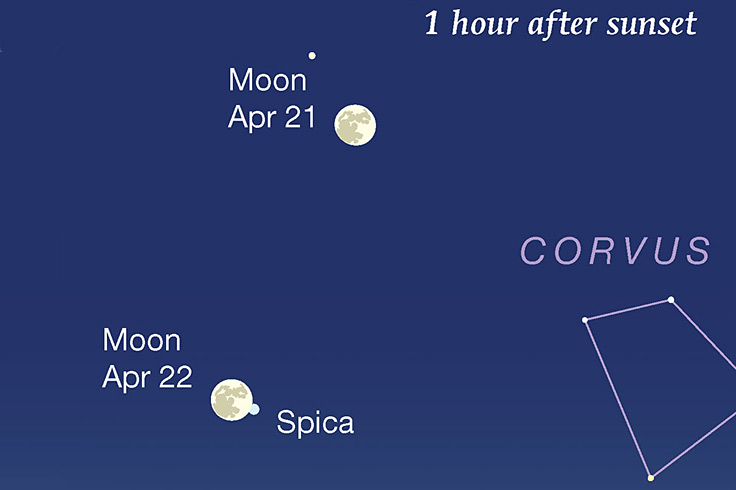
This year the light of the nearly full Moon will interfere, but at least you can determine whether an outburst is in progress at the times you're looking. Watch late on the night of April 21st or before dawn's first light on April 22nd, when the shower's radiant (near Vega) is high in the sky. For mid-northern observers, there's a narrow window around 4 a.m. when the sky is still dark after the Moon has set in the west.
Find observing tips in Sky & Telescope's guide to observing meteors.
Late nights and mornings around April 22nd bring the annual, and highly variable, Lyrid meteor shower. Outbursts of Lyrids have been seen since at least 687 B.C. (when Chinese records say "stars dropped down like rain"), but in most years meteor watchers count 10 to 20 visible per hour under ideal conditions. At intervals of about 12 years the shower occasionally performs more than 10 times as well. But the 12-year cycle itself is very spotty.
Why does it happen at all? The orbital periods of the meteoroids and their source, Comet Thatcher (C/1861 G1), are much longer: about 400 years. Complex gravitational perturbations caused by Jupiter seem to be acting on separate, narrow strands within the overall Lyrid meteoroid stream. Each of these substreams was shed by Comet Thatcher during a past return to the inner solar system.
The Lyrid shower's radiant rises as early as 10 p.m., but you'll likely see more meteors once it climbs much higher in the sky before dawn.
Sky & Telescope diagram
This year the light of the nearly full Moon will interfere, but at least you can determine whether an outburst is in progress at the times you're looking. Watch late on the night of April 21st or before dawn's first light on April 22nd, when the shower's radiant (near Vega) is high in the sky. For mid-northern observers, there's a narrow window around 4 a.m. when the sky is still dark after the Moon has set in the west.
Find observing tips in Sky & Telescope's guide to observing meteors.
Posted by Alan MacRobert, April 21, 2011

OBSERVING BLOG by Alan MacRobert
This Weekend's Twilight Sky Gathering
With spring taking hold and evenings turning softer and more inviting, lots of folks are likely to be outside at dusk this Saturday and Sunday, April 13 and 14. But they may not know the special array of celestial sights that awaits them in the fading twilight, weather permitting.
So, you can tell them.
• First to catch your eye as twilight fades in the west will be the waxing crescent Moon, aimed like a bow almost to the spot where the Sun went down. The Moon grows and climbs higher daily, as shown here.
• Next in view will be Jupiter. It's the brightest thing in this month's evening sky after the Moon.
• Look next for Aldebaran glimmering into view. It's the orange-giant star that marks the fiery eye of mostly invisible Taurus, the Bull.
• As twilight deepens further, look for the V-shaped pattern that Aldebaran makes with the brightest stars of the Hyades cluster. The V is supposed to be the Bull's face, at least in an abstract way.
• And down to the lower right of this is the smaller and more compact Pleiades star cluster: the Seven Sisters, unique in all the sky.
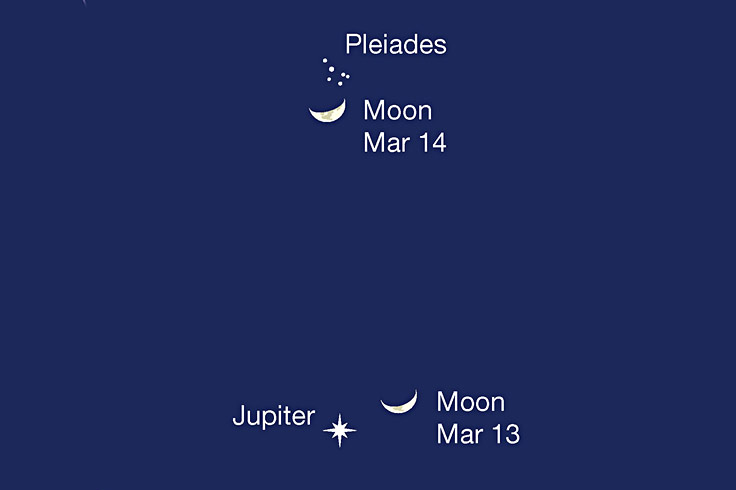
The Moon on Saturday floats between the Hyades and Pleiades. On Sunday it hangs with Jupiter, as shown above; they'll be separated by just a couple of finger-widths at arm's length.
All this awaits anyone with the curiosity to look up. No equipment needed.
If you have a telescope, however, you can take a grander tour. The Moon displays its mountains, plains, myriad craters, and unique little landforms. Jupiter is a flattened ball with pale stripes and four starlike moons of its own, lined up in a row. Lots more Hyades and Pleiades stars come into view.
Even binoculars will show some of this. For instance, they'll reveal that the Hyades star under Aldebaran is a wide double star with slightly contrasting tints.
Got a camera and tripod? Now's the time to try some landscape astrophotography. Aim west, and try shots zoomed in and out to frame different amounts of the scene at different levels of detail. Get some scenery in the foreground. Try a variety of exposure times, and keep what looks best. As for the ISO setting, 400 is a good place to start.
But watch out — if you find that you want to keep fiddling with your camera to improve the results, the astrophotography bug may bite for real, and your life will never be the same.
Pass this on to your friends and relatives. And for bonus science cred: Mention that although these sky sights might look close together there in the west, they're not. They're at a fantastic range of distances. The Moon is 1.3 light-seconds from Earth, Jupiter is currently 47 light-minutes distant, and Aldebaran is 65 light-years in the background. The Hyades stars are 150 light-years out, the Pleiades 400.
So, you can tell them.
• First to catch your eye as twilight fades in the west will be the waxing crescent Moon, aimed like a bow almost to the spot where the Sun went down. The Moon grows and climbs higher daily, as shown here.
• Next in view will be Jupiter. It's the brightest thing in this month's evening sky after the Moon.
• Look next for Aldebaran glimmering into view. It's the orange-giant star that marks the fiery eye of mostly invisible Taurus, the Bull.
• As twilight deepens further, look for the V-shaped pattern that Aldebaran makes with the brightest stars of the Hyades cluster. The V is supposed to be the Bull's face, at least in an abstract way.
• And down to the lower right of this is the smaller and more compact Pleiades star cluster: the Seven Sisters, unique in all the sky.
The Moon on Saturday floats between the Hyades and Pleiades. On Sunday it hangs with Jupiter, as shown above; they'll be separated by just a couple of finger-widths at arm's length.
All this awaits anyone with the curiosity to look up. No equipment needed.
If you have a telescope, however, you can take a grander tour. The Moon displays its mountains, plains, myriad craters, and unique little landforms. Jupiter is a flattened ball with pale stripes and four starlike moons of its own, lined up in a row. Lots more Hyades and Pleiades stars come into view.
Even binoculars will show some of this. For instance, they'll reveal that the Hyades star under Aldebaran is a wide double star with slightly contrasting tints.
Got a camera and tripod? Now's the time to try some landscape astrophotography. Aim west, and try shots zoomed in and out to frame different amounts of the scene at different levels of detail. Get some scenery in the foreground. Try a variety of exposure times, and keep what looks best. As for the ISO setting, 400 is a good place to start.
But watch out — if you find that you want to keep fiddling with your camera to improve the results, the astrophotography bug may bite for real, and your life will never be the same.
Pass this on to your friends and relatives. And for bonus science cred: Mention that although these sky sights might look close together there in the west, they're not. They're at a fantastic range of distances. The Moon is 1.3 light-seconds from Earth, Jupiter is currently 47 light-minutes distant, and Aldebaran is 65 light-years in the background. The Hyades stars are 150 light-years out, the Pleiades 400.
Posted by Alan MacRobert, April 12, 2013
OBSERVING BLOG by Kelly Beatty
Celebrate the Night — This Week, This Month
Amateur skygazers can satisfy their celestial cravings with Globe at Night, International Dark-Sky Week, Astronomy Day, and Global Astronomy Month.
Ah, spring! When a nature-lover's fancy turns to thoughts of … stargazing! After many of us have endured too much cold and too much snow the past few months, it's time to head outdoors to enjoy all that the night sky has to offer. And April, especially, provides many avenues for revitalizing your interest in stargazing.
One quick and easy way is to participate in Globe at Night, a worldwide star-counting exercise that you can do alone or with your family and friends. I'm a big fan of this program, now in its eighth year. Here's how it works. First, you'll need a clear night with minimal interference from moonlight. Next, go outside at least an hour after sunset — say, 8:30 p.m. or later here in the U.S. — and estimate the limiting magnitude of your night sky. Sky charts from Globe at Night make it easy to determine the darkness of your night sky. Then jump online to report your observation. You'll need to know your latitude and longitude, but the website has a mapping tool to help you figure that out. Go for it!
April 5th to 11th is International Dark Sky Week. Also designed to draw attention to light pollution, IDSW was conceived in 2002 by high-school student Jennifer Barlow. She's all grown up now, but her core message is the same: reducing light pollution is a win-win situation that saves energy, reduces greenhouse gases, protects the environment, and improves human health. You can participate in simple ways: check around your home to ensure that outdoor lighting is fully shielded, or at least angled downward; talk to your neighbors about the value of dark skies; attend (or host!) a neighborhood star party! These ideas and more are detailed on the International Dark-Sky Association's IDSW web page.
Coming up fast is Astronomy Day, which this year falls on April 20th. One of the most important and enduring annual stargazing events, Astronomy Day got its start in 1973. It's a high-profile way to draw public attention to the science and the hobby of astronomy through exhibits and activities at urban centers. Astronomy clubs, observatories, museums, colleges, and planetariums worldwide now host special family-oriented Astronomy Day events and festivities. Some organizations extend their activities over an entire week. Check out the Astronomical League's Astro-Day page for details.
Finally, even if you can't find a local venue to whoop it up, you can join the worldwide celebration of the night sky thanks to Global Astronomy Month. Spearheaded by the "One People, One Sky" folks at Astronomers Without Borders, GAM is the world's largest global celebration of astronomy. It embraces all kinds of activities in many different venues: Sun Day, astro-poetry, an astrophoto contest, Jupiter and Saturn "watches", and much more. There are even online-only events like "Walking on the Moon" and the "Cosmic Concert." Check out GAM's program schedule for details.
With so many activities on tap, something here will surely be interesting — even you're just a casual skygazer.
Ah, spring! When a nature-lover's fancy turns to thoughts of … stargazing! After many of us have endured too much cold and too much snow the past few months, it's time to head outdoors to enjoy all that the night sky has to offer. And April, especially, provides many avenues for revitalizing your interest in stargazing.
#checkImageURL( )
Observations by volunteer skygazers during the 2011 Globe at Night campaign (colored dots) appear over a nighttime satellite composite image of the Northeast U.S. and southern Canada.
Globe at Night
April 5th to 11th is International Dark Sky Week. Also designed to draw attention to light pollution, IDSW was conceived in 2002 by high-school student Jennifer Barlow. She's all grown up now, but her core message is the same: reducing light pollution is a win-win situation that saves energy, reduces greenhouse gases, protects the environment, and improves human health. You can participate in simple ways: check around your home to ensure that outdoor lighting is fully shielded, or at least angled downward; talk to your neighbors about the value of dark skies; attend (or host!) a neighborhood star party! These ideas and more are detailed on the International Dark-Sky Association's IDSW web page.
Coming up fast is Astronomy Day, which this year falls on April 20th. One of the most important and enduring annual stargazing events, Astronomy Day got its start in 1973. It's a high-profile way to draw public attention to the science and the hobby of astronomy through exhibits and activities at urban centers. Astronomy clubs, observatories, museums, colleges, and planetariums worldwide now host special family-oriented Astronomy Day events and festivities. Some organizations extend their activities over an entire week. Check out the Astronomical League's Astro-Day page for details.
Finally, even if you can't find a local venue to whoop it up, you can join the worldwide celebration of the night sky thanks to Global Astronomy Month. Spearheaded by the "One People, One Sky" folks at Astronomers Without Borders, GAM is the world's largest global celebration of astronomy. It embraces all kinds of activities in many different venues: Sun Day, astro-poetry, an astrophoto contest, Jupiter and Saturn "watches", and much more. There are even online-only events like "Walking on the Moon" and the "Cosmic Concert." Check out GAM's program schedule for details.
With so many activities on tap, something here will surely be interesting — even you're just a casual skygazer.
Posted by Kelly Beatty, April 5, 2013

OBSERVING BLOG by Sean Walker
Comet PanSTARRS Offers M31 Photo Op
Skywatchers in the latitudes of the northern U.S., Canada, and much of Europe are getting better conditions for observing and photographing Comet PanSTARRS — even as the comet fades as it flies away from both Sun and Earth.
Throughout the first week of April, the comet is making a wonderfully photogenic pass by the Andromeda Galaxy, M31, presenting astrophotographers at northerly locations with a unique opportunity. The image above was taken on the morning of April 4th, and this deep image was taken on March 30th. The comet passed closest to the showpiece galaxy in the early hours of April 4th UT. The tail continues to widen as seen from Earth's perspective.
The comet is now actually higher before dawn, in the northeastern sky. But the waning Moon is up then (though dimmer every morning; last quarter was on the 3rd). Evening is when northern imagers can catch this departing visitor with no interference from either twilight or moonlight. The farther north of 40° latitude you are the better.
Some recent brightness estimates put the comet at about 4th magnitude, slightly fainter than M31. Other observers say it's slightly brighter than the galaxy. This depends on the darkness and quality of your sky; the comet's head is more concentrated and has a higher surface brightness than the galaxy's inner portion.
As for visual sightings, from my latitude of 43° I could not see it naked-eye on March 30th, though it was still easily visible in my 70mm spotting scope.
From latitude 49° Alan Whitman in Penticton, British Columbia,writes,
"On March 31st with excellent transparency, Comet PanSTARRS was visible with the unaided eye exactly two hours after sunset. It is now in the same binocular field of view as 3.4-magnitude M31, and the comet is about 0.5 magnitude brighter than the galaxy, making the comet about magnitude 3.
"In a 4.2-inch Astroscan at 64x, the broad, fanned tail was about 0.7° long, sharper and slightly curved on the preceeding edge. The pseudonucleus is nearly stellar."
Send us your observations and photographs! Post your pix in the Comet PanSTARRS section of our Photo Gallery.
Also, this amazing shot was taken by Michael Jaeger and Hohe Tauern on April 1st.
Posted by Sean Walker, April 2, 2013
OBSERVING BLOG by Kelly Beatty
March 28th's Celestial Sandwich
If you're up in late evening on Thursday, March 28th, check out the brilliant, nearly full Moon and its two lovely attendants: the ringed planet Saturn and the icy-white star Spica.
Just about every night, after the 11 o'clock news and just before heading off to bed, I take a moment to walk outside and look up into the sky. If it's clear, there's always something worth seeing. Last Sunday, for example, I was greeted by the close pairing of a crescent Moon and Jupiter. Lovely, indeed!
If it's clear on the night of Thursday, March 28th, I'll be on the lookout (and you should too) for a just-past-full Moon perched midway between the icy-white star Spica to its upper right and creamy-hued Saturn to its lower left. This grouping won't be particularly tight — Saturn and Spica are currently 17° apart, about twice the width of your fist at arm's length — but it will still look nice.
This wide spacing actually helps you take in the trio. Ordinarily such a big, fat Moon would wash out anything in its vicinity. But Spica is no slouch: it's a 1st-magnitude blue giant. Saturn reaches opposition late next month, so it's already a half magnitude brighter than Spica. Look for the trio after 11 p.m., after they've had some time to clear the eastern horizon and are well up in the southeast.
Were I on the other side of the world (say, in Mumbai, India), the Moon would appear dramatically close to Spica on the 28th and just 3° from Saturn the next night. In fact, the Moon actually occults (covers up) Spica beginning around 13h Universal Time as seen from much of southeast Asia and northern Australia. Details are available here.
For the rest of us, March 28th's celestial sandwich will simply be a nice moment to enjoy. Reflected sunlight takes about 1¼ seconds to reach us from the Moon's bleak, dusty surface. For Saturn, now just under 9 astronomical units (830 million miles) away, the travel time is 74 minutes. And the light from Spica, a star that shines 12,000 times brighter than our Sun, has been traveling about 260 years — since well before the American Revolution.
Just about every night, after the 11 o'clock news and just before heading off to bed, I take a moment to walk outside and look up into the sky. If it's clear, there's always something worth seeing. Last Sunday, for example, I was greeted by the close pairing of a crescent Moon and Jupiter. Lovely, indeed!
Late on March 28th, the nearly full Moon is situated halfway between Saturn and Spica for observers in the Western Hemisphere.
Sky & Telesope diagram
This wide spacing actually helps you take in the trio. Ordinarily such a big, fat Moon would wash out anything in its vicinity. But Spica is no slouch: it's a 1st-magnitude blue giant. Saturn reaches opposition late next month, so it's already a half magnitude brighter than Spica. Look for the trio after 11 p.m., after they've had some time to clear the eastern horizon and are well up in the southeast.
Were I on the other side of the world (say, in Mumbai, India), the Moon would appear dramatically close to Spica on the 28th and just 3° from Saturn the next night. In fact, the Moon actually occults (covers up) Spica beginning around 13h Universal Time as seen from much of southeast Asia and northern Australia. Details are available here.
For the rest of us, March 28th's celestial sandwich will simply be a nice moment to enjoy. Reflected sunlight takes about 1¼ seconds to reach us from the Moon's bleak, dusty surface. For Saturn, now just under 9 astronomical units (830 million miles) away, the travel time is 74 minutes. And the light from Spica, a star that shines 12,000 times brighter than our Sun, has been traveling about 260 years — since well before the American Revolution.
Posted by Kelly Beatty, March 22, 2013

OBSERVING BLOG by Tony Flanders
The Moon Salutes Jupiter
On the evening of Sunday, March 17th, stargazers all across the Americas will be able to watch the Moon pass spectacularly close to Jupiter, the third brightest object in the night sky after the Moon and Venus.
Jupiter will remain quite close to the Moon all evening — just the width of one or two fingers held at arm's length. But their closest approach will come around 11 p.m. EDT or 8 p.m. PDT. At that point, the cusps of the crescent Moon will point directly toward Jupiter on one side and the bright star Aldebaran on the other. Normally, Aldebaran appears extremely bright, but it pales by comparison with its dazzling neighbors.
Binoculars show the scene beautifully, including the stars of the Hyades cluster between Aldebaran and the Moon as well as many craters and mountains on the Moon itself. And if you can hold them steady enough, they will also show Jupiter's outer moons Ganymede and Callisto flanking it on either side. But binoculars are unlikely to show the inner moons Io and Europa, which will either be very close to Jupiter or hidden behind it.
If you have a telescope, you might want to watch Europa disappear behind Jupiter around 10:48 p.m. EDT (7:48 PDT) and Io at 12:14 a.m. EDT (9:14 p.m. PDT). Our JupiterMoons app for mobile Apple devices can guide you to future satellite crossings and eclipses.
Sky & Telescope
Binoculars show the scene beautifully, including the stars of the Hyades cluster between Aldebaran and the Moon as well as many craters and mountains on the Moon itself. And if you can hold them steady enough, they will also show Jupiter's outer moons Ganymede and Callisto flanking it on either side. But binoculars are unlikely to show the inner moons Io and Europa, which will either be very close to Jupiter or hidden behind it.
If you have a telescope, you might want to watch Europa disappear behind Jupiter around 10:48 p.m. EDT (7:48 PDT) and Io at 12:14 a.m. EDT (9:14 p.m. PDT). Our JupiterMoons app for mobile Apple devices can guide you to future satellite crossings and eclipses.
Posted by Tony Flanders, March 13, 2013
OBSERVING BLOG by Kelly Beatty
Earth Briefly Gains Third Radiation Belt
Just days after launching twin spacecraft deep into Earth's magnetosphere, space physicists were rewarded with the discovery of a third region of trapped high-energy particles in the Van Allen radiation belts.
I'm not quite old enough to remember the launch of Explorer 1, the first U.S. satellite, on February 1, 1958. Nor do I recall the news that a Geiger-tube detector on board, the handiwork of James Van Allen (University of Iowa) and his students, had detected two broad belts of high-energy charged particles trapped in Earth's magnetosphere. Van Allen was as surprised as anyone by the discovery — he'd hoped instead to record cosmic rays from deep space — but it made his a household name. Van Allen and his radiation belts even made the cover of Time magazine in 1959.
Because the particles are charged, they're confined to specific doughnut-shaped regions within the magnetosphere, spiraling up and down along field lines at relativistic speeds (which is what makes them harmful). The inner belt, ranging in height from about 1,000 to 8,000 miles, consists of protons and electrons. The outer belt, almost entirely electrons, ranges from 12,000 to 25,000 miles, and the two regions are ordinarily separated by a nearly empty gap or "slot".
Now another set of Van Allen namesakes have altered this simple picture. NASA launched two identical Radiation Belt Space Probes last August 30th, and by the time the agency renamed them the Van Allen Probes in early November they'd already found something remarkable: a third region of trapped radiation high above Earth.
As detailed in last week's online issue of Science, a team led by Daniel Baker (University of Colorado) describes how the Van Allen Probes recorded a third region of energetic electrons that appeared between the two "classic" belts for about a month. During that time the outer belt became distinctly weaker and even disappeared for about a week. Then the mysterious third component waned and the outer belt reformed.
Baker's team doesn't know what caused this series of events — the outer belt is notoriously changeable. For example, it's not clear whether the enhancement seen by the probes represents a distinct third region or instead some unexplained splitting of the outer belt. But the probes will monitor the dynamic goings-on out there for at least two years, perhaps shedding light on how charged particles arise both around other planets and elsewhere in the universe. "We're very lucky," notes Mona Kessel, the mission's program scientist . "It's rather like having a particle accelerator in our backyard."
You can read more about the third belt in NASA's press release, but it'll make more sense to watch last week's press briefing.
Here are two interesting sidelights to this story. The first is that the Van Allen Probes recorded these dramatic changes only because their Relativistic Electron-Proton Telescopes (REPTs) were turned on right away. Mission scientists wanted to get some data before another NASA space sentinel called SAMPEX (short for "Solar, Anomalous, and Magnetospheric Particle Explorer") reentered the atmosphere after a 20-year mission. Normally, Baker explains, the REPT instruments wouldn't have been activated for at least a month; instead, the team turned them on just two days after launch. "We were very fortunate that we did," he adds.
The second bit of backstory involves a tale of Cold War secrecy that backfired. It turns out that Sputnik 2, which famously carried the dog Laika into space three months before Explorer 1 reached orbit, also carried a Geiger-tube detector. Built by Russian cosmic-ray expert Sergey Vernov and his colleagues, the detector worked just fine for several days and no doubt registered intense levels of energetic particles each time the craft neared its orbit's 1,000-mile-high apogee.
But, as space historian Don Mitchell recounts, the classified data transmissions from Sputnik 2 could only be received when the craft was over the U.S.S.R. — and near perigee. Had the team been allowed to ask for tracking help from abroad, this story might have been all about the "Vernov Belts."
Holding aloft a model of Explorer 1 at a post-launch press conference in 1958 are (from left): William H. Pickering of the Jet Propulsion Laboratory; James A. Van Allen, whose instrument discovered radiation belts encircling Earth; and Wernher von Braun, leader of the US Army team that built the Juno launch rocket (model at lower right).
NASA
Because the particles are charged, they're confined to specific doughnut-shaped regions within the magnetosphere, spiraling up and down along field lines at relativistic speeds (which is what makes them harmful). The inner belt, ranging in height from about 1,000 to 8,000 miles, consists of protons and electrons. The outer belt, almost entirely electrons, ranges from 12,000 to 25,000 miles, and the two regions are ordinarily separated by a nearly empty gap or "slot".
Now another set of Van Allen namesakes have altered this simple picture. NASA launched two identical Radiation Belt Space Probes last August 30th, and by the time the agency renamed them the Van Allen Probes in early November they'd already found something remarkable: a third region of trapped radiation high above Earth.
Normally only two Van Allen belts (enhancements of charged particles, seen in cross-section in the upper panel) are trapped in Earth's magnetosphere. However, in September 2012, sensors aboard NASA spacecraft recorded three belts (lower panel). Click on the image to see an animation of the belts' evolving appearance.
NASA / JHU-APL / Univ. of Colorado
Baker's team doesn't know what caused this series of events — the outer belt is notoriously changeable. For example, it's not clear whether the enhancement seen by the probes represents a distinct third region or instead some unexplained splitting of the outer belt. But the probes will monitor the dynamic goings-on out there for at least two years, perhaps shedding light on how charged particles arise both around other planets and elsewhere in the universe. "We're very lucky," notes Mona Kessel, the mission's program scientist . "It's rather like having a particle accelerator in our backyard."
You can read more about the third belt in NASA's press release, but it'll make more sense to watch last week's press briefing.
The Relativistic Electron Proton Telescope (REPT) turned on just two days after launch, mapping electron fluxes as the Van Allen Probes sped through the radiation belts. Each line in the diagram shows one orbit, and the color bar on the right shows the intensity of electron flux. Scientists watched the the outer electron belt spread and fade dramatically over the course of one month. Observing, and then predicting how the radiation belts react in response to solar activity is one of the goals of the Van Allen Probes' mission.
JHU / APL, NASA
The second bit of backstory involves a tale of Cold War secrecy that backfired. It turns out that Sputnik 2, which famously carried the dog Laika into space three months before Explorer 1 reached orbit, also carried a Geiger-tube detector. Built by Russian cosmic-ray expert Sergey Vernov and his colleagues, the detector worked just fine for several days and no doubt registered intense levels of energetic particles each time the craft neared its orbit's 1,000-mile-high apogee.
But, as space historian Don Mitchell recounts, the classified data transmissions from Sputnik 2 could only be received when the craft was over the U.S.S.R. — and near perigee. Had the team been allowed to ask for tracking help from abroad, this story might have been all about the "Vernov Belts."
Posted by Kelly Beatty, March 4, 2013
OBSERVING BLOG by Kelly Beatty
The Moon Meets (and Hides) Spica
On the night of February 28th, skywatchers in the Americas will be treated to an especially close pairing of a waning gibbous Moon with Virgo's alpha star. Those positioned in Central and South America might even see Spica occulted.
Every month the Moon dutifully cycles all around the sky, and we scarcely pay attention to which stars might be in its immediate vicinity.
However, late on the night of Thursday, February 28th, a waning gibbous Moon passes very close to Spica, the alpha star in the constellation Virgo, the Maiden. In fact, they'll be close enough that the Moon's eastward orbital motion should be apparent hour by hour.
The lunar disk is 86% sunlit, which ordinarily creates so much glare that your eye can't pick out nearby stars. But icy-white Spica is a 1st-magnitude sparkler that should hold its own as the Moon draws near. The views through binoculars or a small telescope should be excellent.
Skywatchers in the Americas have the best seats for this late-evening show, but the pairing's closeness depends on both your latitude and longitude. The farther south and west you are, the better.
For example, from Los Angeles the Moon appears less than 10 arcminutes to Spica's lower right at about 9:30 p.m. PST, not long after the two rise on the 28th. But from Boston the Moon passes slightly farther away, 30 arcminutes (one lunar diameter), at about 1 a.m. EST on March 1st.
If you happen to be along the Pacific Coast of Mexico or Central America, or anywhere in central South America, the Moon occults Spica. From Acapulco, Mexico, Spica disappears behind the Moon's bright northern limb at 11:21 p.m. local time on February 28th and reappears from behind the dark limb 37 minutes later.
For occultation times and circumstances for cities throughout Central and South America, see IOTA's posting for this event.
Due to the Moon's current path among the stars, occultations of Spica occur throughout 2013. But the only one particularly favorable for North America doesn't occur until November 29th.
The night of February 28th features an especially close pairing of Spica and the Moon.
Sky & Telesope diagram
However, late on the night of Thursday, February 28th, a waning gibbous Moon passes very close to Spica, the alpha star in the constellation Virgo, the Maiden. In fact, they'll be close enough that the Moon's eastward orbital motion should be apparent hour by hour.
The lunar disk is 86% sunlit, which ordinarily creates so much glare that your eye can't pick out nearby stars. But icy-white Spica is a 1st-magnitude sparkler that should hold its own as the Moon draws near. The views through binoculars or a small telescope should be excellent.
Skywatchers in the Americas have the best seats for this late-evening show, but the pairing's closeness depends on both your latitude and longitude. The farther south and west you are, the better.
This view simulates what skywatchers in Los Angeles will see around 9:45 p.m. PST on February 28th. The Moon occults Spica from portions of Central and South America.
Stellarium
If you happen to be along the Pacific Coast of Mexico or Central America, or anywhere in central South America, the Moon occults Spica. From Acapulco, Mexico, Spica disappears behind the Moon's bright northern limb at 11:21 p.m. local time on February 28th and reappears from behind the dark limb 37 minutes later.
For occultation times and circumstances for cities throughout Central and South America, see IOTA's posting for this event.
Due to the Moon's current path among the stars, occultations of Spica occur throughout 2013. But the only one particularly favorable for North America doesn't occur until November 29th.
Posted by Kelly Beatty, February 22, 2013

OBSERVING BLOG by Tony Flanders
Mercury Meets Mars
Mercury and Mars appear spectacularly close to each other shortly after sunset on February 7th and 8th. This is a rare opportunity to see the two smallest planets together in a single telescopic field of view.
This is fairly early in Mercury's fine evening apparition; it will be considerably higher a week later. But as long as the air is clear and your location has an unobstructed view to the west, you should have no trouble spotting Mercury a half hour after sunset as a tiny pinprick of light in the bright glow. Mars is only one-tenth as bright and may require binoculars or a telescope.
Mars is about ¾° upper left of Mercury on the 7th and less than ½° lower left of Mercury on the 8th. That means that they should fit in a single telescopic field of view at 80× on the 7th and more than 100× on the 8th. That's enough magnification to see both planets' tiny disks assuming that you catch them early, while they're still relatively high, and that the atmosphere is steady.
Mars appears just 4" across and almost perfectly round, while Mercury is a gibbous shape about 80% illuminated and 5.8" tall. Mars is actually bigger than Mercury, but it appears smaller because it's farther away — almost on the opposite side of the Sun from Earth. See our SkyWeek video for more information on Mercury and Mars.
This is fairly early in Mercury's fine evening apparition; it will be considerably higher a week later. But as long as the air is clear and your location has an unobstructed view to the west, you should have no trouble spotting Mercury a half hour after sunset as a tiny pinprick of light in the bright glow. Mars is only one-tenth as bright and may require binoculars or a telescope.
Mars is about ¾° upper left of Mercury on the 7th and less than ½° lower left of Mercury on the 8th. That means that they should fit in a single telescopic field of view at 80× on the 7th and more than 100× on the 8th. That's enough magnification to see both planets' tiny disks assuming that you catch them early, while they're still relatively high, and that the atmosphere is steady.
Mars appears just 4" across and almost perfectly round, while Mercury is a gibbous shape about 80% illuminated and 5.8" tall. Mars is actually bigger than Mercury, but it appears smaller because it's farther away — almost on the opposite side of the Sun from Earth. See our SkyWeek video for more information on Mercury and Mars.
Posted by Tony Flanders, January 31, 2013


Other links: + digg | + reddit | + del.icio.us | + rss
Read comments (1)